
Tile Roof Lift & Relay Cost: Southern California 2026 Guide
Most homeowners believe a leaking tile roof automatically means they're facing a $30,000 replacement bill, but they're usually wrong. You've likely felt that pit in your stomach after the first major Southern California rain when a new ceiling stain appears. It's frustrating to receive conflicting quotes from contractors who seem more interested in selling you a whole new system than preserving your existing investment. Understanding the actual tile roof lift and relay cost is the first step toward protecting your home without draining your savings.
We agree that your roof should be a source of security, not a source of financial stress. In this 2026 guide, we promise to pull back the curtain on regional pricing factors and show you how a lift and relay can save you thousands compared to a full replacement. We'll preview the impact of the latest Title 24 energy standards, explain why the underlayment is the true hero of your roofing system, and provide the clarity you need to make an informed decision for your home in Riverside, Orange, or San Diego County. A leak-free roof for twenty years. Significant cost savings. Professional results you can trust.
Key Takeaways
- Understand why durable concrete and clay tiles often outlive their felt underlayment, creating a need for targeted maintenance rather than total replacement.
- Learn how a professional lift and relay provides a leak-free solution for over 20 years at approximately half the expense of a full new roof.
- Discover the specific factors that influence your tile roof lift and relay cost, including the labor-intensive process of hand-stacking and preserving existing tiles.
- Identify the technical steps of a professional relay, from maintaining structural weight on your rafters to performing deep inspections for hidden deck rot.
- Gain insights into navigating 2026 Southern California building codes and Title 24 requirements with a trusted local expert from the Inland Empire.
What is a Tile Roof Lift and Relay?
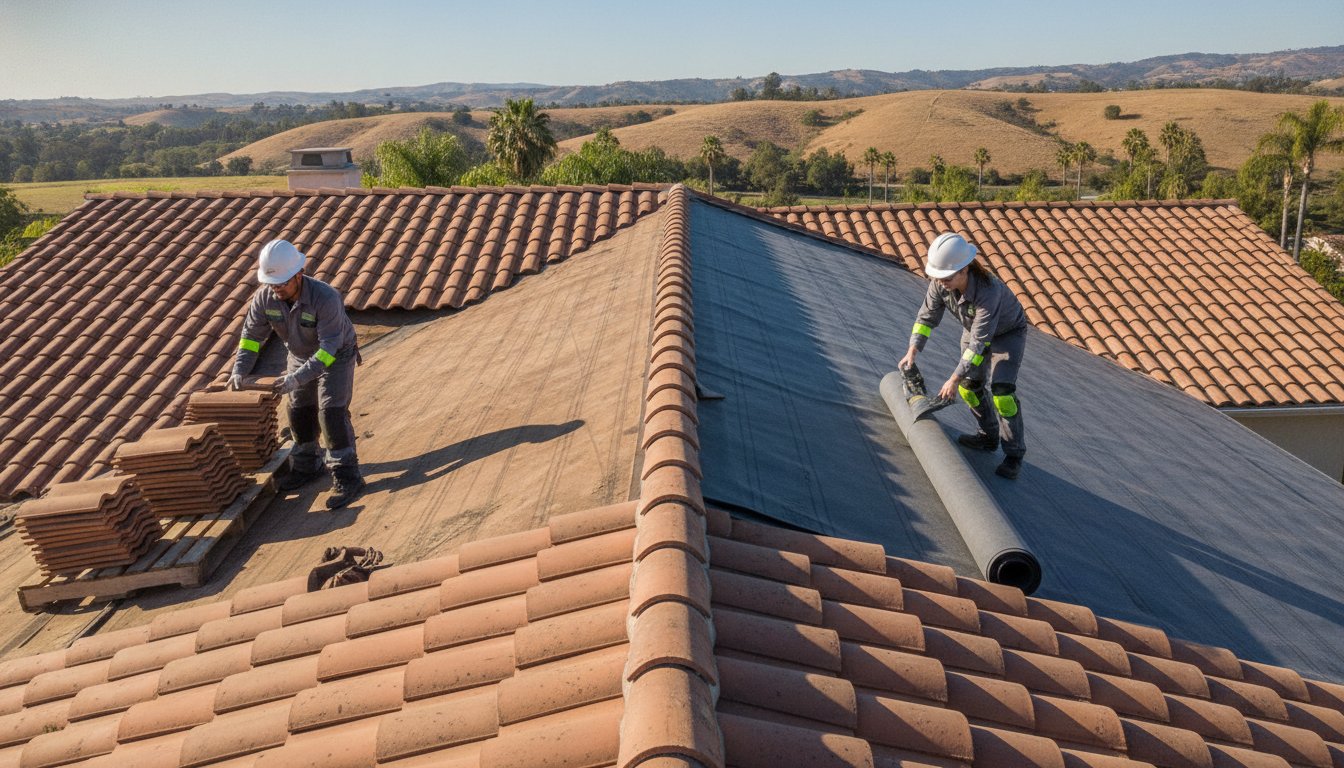
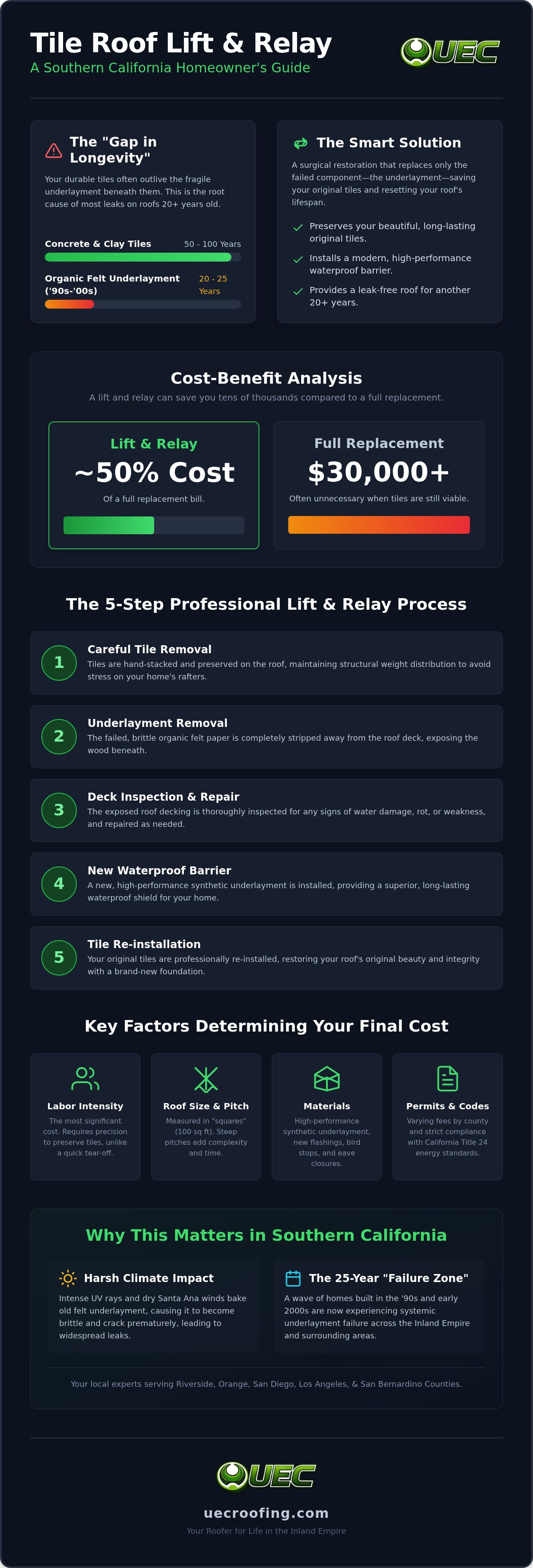
A lift and relay is a specialized restoration process where we carefully remove your existing roof tiles, strip away the failed underlayment, and install a brand-new waterproof barrier before reinstalling the original tiles. Roof tiles made of clay or concrete are incredibly durable, often lasting 50 to 100 years. However, the organic felt paper beneath them is the weak link. This "Gap in Longevity" means your tiles are still in great shape while the waterproof skin underneath has turned to dust. It's a surgical approach to roofing that focuses on the components that actually fail.
Our unique environment in the Inland Empire and across San Diego and Los Angeles Counties accelerates this decay. Intense UV rays bake the tiles, which then transfer that heat directly to the underlayment. Dry Santa Ana winds also play a role, stressing the system over decades. By choosing a relay, you essentially reset the clock on your roof’s lifespan. It's a strategic move that addresses the core issue without the high expense of a full replacement. You keep the aesthetic you love while gaining the protection you need.
The Role of Underlayment in Tile Systems
Think of your tiles as the armor and the underlayment as the waterproof skin. In the 1990s and early 2000s, most Southern California builders used standard organic felt. This material dries out and cracks after about 20 to 25 years. We now see a massive wave of homes in Lake Elsinore and Riverside hitting this "failure zone." Modern high-performance synthetic underlayments offer far better heat resistance and durability. They don't rot or become brittle like the old felt systems did under the SoCal sun.
Lift and Relay vs. Simple Leak Repair
Many homeowners try to save money by patching individual leaks. This is often just a band-aid on a systemic problem. If your underlayment has failed in one valley or around one chimney, it's likely brittle everywhere else. Constant small repairs can eventually exceed the total Expert Roof Leak Repair in Riverside CA costs if you don't address the root cause. Investing in a comprehensive relay protects your property value and prevents the repair cycle that never seems to end. Understanding the eventual tile roof lift and relay cost helps you plan for long-term stability rather than temporary fixes.
Factors That Determine Tile Roof Lift and Relay Cost
Roofing professionals don't typically quote a flat price for an entire project. Instead, we measure your home in "squares." One roofing square equals 100 square feet of surface area. This standardized measurement allows for a more accurate assessment of the tile roof lift and relay cost. It ensures you only pay for the specific footprint of your home. Using squares helps us account for the exact amount of underlayment and labor required for your unique roofline in Riverside or Orange County.
Labor is the most significant variable in a relay project. Unlike a full replacement where old materials are quickly discarded, a lift and relay requires surgical precision. Our crews must hand-stack and preserve your existing tiles to avoid breakage. This process is physically demanding and time-intensive. We treat your tiles like the valuable investment they are, ensuring they remain staged safely on the roof rafters to maintain proper weight distribution. This careful handling prevents structural stress while the waterproof barrier is being replaced.
Your home's architecture also influences the final estimate. A steep pitch or a multi-story residence in San Diego requires specialized safety equipment and additional man-hours. It simply takes longer to move materials on a steep incline than on a low-slope roof. Local building departments in counties like Los Angeles and San Bernardino also have varying permit fees. We ensure every project complies with the California Residential Code for roof assemblies, which dictates specific installation standards for clay and concrete tiles.
Material Variables: Underlayment and Flashings
The choice of underlayment is where quality truly shines. While some contractors still use 40lb organic felt, we recommend high-performance synthetic systems. These dual-layer barriers withstand the intense Inland Empire heat much better than traditional paper. We also replace critical components like lead or galvanized flashings during the relay. Small details like "bird stops" and eave closures are essential. They prevent debris and pests from entering the gaps under your tiles, extending the life of your new underlayment.
The "Hidden" Cost: Decking and Wood Repair
Unexpected wood damage is common in older Southern California homes. Once we lift the tiles, we often find dry rot or termite damage that was invisible from the ground. Most professional quotes include a "per sheet" price for plywood or a "per linear foot" price for fascia and starter boards. At UEC Roofing, we believe in total transparency. We perform a technical inspection of the deck as soon as the tiles are removed. If you suspect your roof has hidden damage, our team can provide a professional inspection to identify these issues before the first rain hits.
Lift and Relay vs. Full Replacement vs. Rejuvenation
Choosing the right path for your roof depends on the current health of your tiles and your long-term goals. If your tiles are structurally sound, the lift and relay is almost always the most logical choice. On average, you can expect nearly 50% savings when compared to a full new roof installation. This isn't just a financial win. It's also an environmental one. By reusing your existing concrete or clay tiles, you keep thousands of pounds of heavy material out of Southern California landfills. It’s a sustainable way to manage your tile roof lift and relay cost while securing your home for the next two decades.
We use a simple framework to help homeowners in Lake Elsinore and the surrounding Inland Empire decide. If your underlayment is leaking but the tiles are intact, we relay. If the tiles themselves are crumbling, we replace. Most homeowners find that a relay offers the best return on investment because it addresses the actual source of leaks while preserving the expensive "armor" you already own. It's a professional solution that avoids the $30,000 to $50,000 price tag of a total tear-off and new tile purchase.
When is a Full Replacement Necessary?
Sometimes, tiles reach the end of their functional life. If you notice spalling, where the surface of the tile begins to flake or crumble, or if a significant percentage of your tiles are too brittle to handle, a relay may not be viable. In these cases, upgrading to modern cool-roof tiles is often the best move. These tiles meet 2026 Title 24 standards and significantly reduce attic temperatures during our brutal San Bernardino County summers. For a deeper look at total project pricing, check our Roof Replacement Cost in Southern California guide.
The Role of Roof Rejuvenation
You might have heard about rejuvenation as a way to extend roof life. It's vital to understand that traditional roof rejuvenation is typically a chemical treatment designed for asphalt shingles to restore flexibility. It rarely addresses the systemic underlayment failure found in tile systems. However, we often use a specialized aesthetic rejuvenation after a relay to give aged tiles a fresh, uniform look. If you are debating between these methods, our Roof Rejuvenation vs Replacement guide breaks down which treatment suits specific material types.
The Professional Lift and Relay Process
Executing a lift and relay requires more than just muscle. It demands a technical understanding of structural loads and waterproofing. At UEC Roofing, we follow a disciplined four-step process to ensure your home in Riverside or San Bernardino County is protected for decades. We start with staging and tile removal. Unlike inexperienced crews who might toss tiles into a bin, we hand-stack them on your roof rafters. This preserves the "loading" weight. It prevents your home's structural framing from shifting or popping drywall nails inside your ceiling while the tiles are off.
Once the deck is exposed, we move to a technical inspection. We look for dry rot, termite damage, or sagging plywood that often hides beneath old felt in the Inland Empire. After clearing the deck, we install high-performance synthetic underlayment and new wood battens. These battens create a critical air gap that helps with attic ventilation and energy efficiency. Finally, we perform the precision relaying. We carefully fit your original tiles back into place and replace any broken units with matching pieces. This systematic approach ensures your tile roof lift and relay cost provides the maximum possible value.
Critical Details: Flashings and Valleys
Valleys are the primary failure point on Southern California roofs. Debris from nearby trees often collects in these channels, creating water dams that force moisture under the tiles. We install "W-valley" metal to provide a wider, more efficient path for runoff. We also ensure that all chimney and wall flashings are fully integrated with your new underlayment. These transition points are where most leaks begin, so we treat them with extra care to ensure a watertight seal for homes in Orange and San Diego Counties.
Timeline and Homeowner Preparation
A typical relay project takes between 3 and 7 days. You should expect some noise and dust during the stripping phase. We take extensive measures to protect your property. We use specialized covers for your landscaping and boards to protect your driveway from heavy equipment. For a more detailed breakdown of what to expect, read our Lift and Relay Roofing Service Guide. If you want to ensure your home is ready for the next rainy season, schedule a professional inspection with our Lake Elsinore team today.
Maximizing ROI: Choosing the Right SoCal Contractor
Hiring a general handyman or a "Chuck in a truck" for a tile project often leads to disaster. Tile systems are heavy and complex. One wrong move can crack dozens of tiles or compromise the structural integrity of your rafters. You need a specialist who understands the nuances of the Inland Empire’s climate. A local expert with a physical office in Lake Elsinore provides a level of accountability that out-of-town contractors simply cannot match. With a track record of over 2,000 successful projects, we focus on being your "Roofer for Life" through transparent communication and ethical standards.
Reliability is the cornerstone of your investment. Always verify that your contractor carries active workers' compensation and liability insurance specifically for roofing. This protects you from legal headaches if an accident occurs on your property. When you evaluate the total tile roof lift and relay cost, the cheapest bid is rarely the safest. Quality workmanship ensures you won't be searching for another contractor after the next Santa Ana windstorm hits Riverside or San Bernardino County.
Evaluating Your Quote
A professional estimate should be detailed and transparent. One major red flag is a contractor suggesting you reuse old lead or galvanized flashings to save money. This is a shortcut that almost always leads to premature leaks. Your quote must also include a clear, written warranty covering both labor and materials. In 2026, ensure your contractor understands the latest California building codes regarding "Cool Roof" compliance. These standards are mandatory for many major renovations in Los Angeles and Orange Counties. Asking about these specifics separates the true professionals from the amateurs.
Preparing for the Rainy Season
Timing is everything when it comes to roofing. Summer and fall are the peak seasons for relays in Southern California. You want your system fully sealed before the winter rains arrive in San Diego. If your roof is less than 15 years old and you haven't seen active leaks, a full relay might not be necessary yet. In those cases, our Roof Tune-Up Service is an excellent preventative step. It addresses minor issues like slipped tiles or debris-filled valleys before they turn into expensive emergencies. Protect your family and your property value by being proactive rather than reactive.
Secure Your Home for the Next Two Decades
Your roof is the most critical investment you make to protect your family and property value. By choosing a professional relay, you address the failed underlayment while keeping your durable tiles in place. This surgical approach significantly reduces your tile roof lift and relay cost compared to a full tear-off and replacement. You gain a leak-free system that meets modern California building codes without the unnecessary expense of buying brand new materials. It's the most responsible way to manage your home's long-term health in our harsh Southern California climate.
UEC Roofing brings the quiet confidence of a local expert to every project. We've completed over 2,000 successful roofing projects across Riverside, San Diego, and Orange Counties. As specialists in tile systems and leak restoration, our Lake Elsinore team understands exactly what it takes to weather the next Santa Ana windstorm. Don't wait for the next major rain to discover a problem. Schedule Your Professional Tile Roof Inspection Today and let us help you protect your investment. We look forward to providing the peace of mind you deserve.
Frequently Asked Questions
How much does a tile roof lift and relay cost compared to a new roof?
A lift and relay typically costs about half of what a full roof replacement would. Since you reuse the existing tiles, you're primarily paying for labor and new underlayment. This makes it a highly cost-effective option for homeowners in Riverside and San Diego who want to extend their roof's life by 20 years or more without the expense of buying new clay or concrete materials. It's the most strategic way to handle aging systems.
Can I reuse my existing tiles if they are 30 years old?
Yes, you can usually reuse your tiles if they aren't crumbling or spalling. Most concrete and clay tiles are built to last over 50 years, while the felt paper underneath only lasts about 20. We carefully inspect your tiles during the removal phase. This preservation is a key factor in keeping the tile roof lift and relay cost manageable for Inland Empire residents who want to avoid a total replacement.
How long does a lift and relay service typically take?
The process usually takes between 3 to 7 business days for most residential properties. This timeline depends on the roof's size, complexity, and pitch. We spend the first day or two carefully removing and staging tiles on the rafters. The middle days involve stripping the deck and installing new underlayment. We finish by relaying the tiles and performing a final inspection to ensure a watertight finish for your Lake Elsinore home.
Will a lift and relay stop all my roof leaks?
A professional relay is designed to stop systemic leaks by replacing the entire waterproof barrier. While a simple patch only fixes a localized problem, a relay provides a brand-new skin across the entire roof deck. We also replace flashings and valley metal, which are common failure points. This comprehensive approach ensures your home in Orange County stays completely dry even during the heaviest Southern California winter rainstorms.
Is a permit required for a roof lift and relay in Riverside County?
Yes, most cities and counties in Southern California require a permit for this type of work. Riverside County has specific building codes to ensure structural safety and fire resistance. As a professional contractor based in Lake Elsinore, we handle the entire permitting process for you. This ensures your project complies with the latest 2026 standards and protects your property's resale value and insurance coverage. It's a critical step for any major renovation.
What is the best underlayment for a tile roof in the Southern California heat?
We recommend high-performance synthetic underlayments or rubberized asphalt membranes for our local climate. These materials resist the intense UV rays and high temperatures common in San Bernardino and Los Angeles Counties much better than traditional organic felt. They don't dry out or crack as easily. Choosing a premium underlayment is a smart investment that maximizes the long-term value of your tile roof lift and relay cost while protecting your home's interior.
Does a lift and relay improve my home’s energy efficiency?
It definitely can improve efficiency. We often install new wood battens to create an air gap between the deck and the tiles. This gap allows for better airflow, which reduces heat transfer into your attic. When combined with the latest "cool roof" standards required by Title 24, a relay helps lower your monthly energy bills during those sweltering Inland Empire summers. It's an investment that pays off in comfort and savings.
How often should a tile roof undergo a lift and relay?
You should only need a lift and relay every 20 to 30 years. This matches the expected lifespan of modern high-quality underlayment. We suggest a professional inspection every three to five years to check for slipped tiles or debris buildup in the valleys. This preventative maintenance helps you avoid major issues and ensures your roofing system protects your Southern California property for its full intended lifespan without requiring early intervention.