
Roof Felt Replacement Cost in Southern California: 2026 Homeowner’s Guide
What if the most critical part of your Southern California roof is the layer you can't even see? Most homeowners in Lake Elsinore and the Inland Empire assume their heavy tiles do all the heavy lifting, but it's the underlayment that truly keeps your family dry. When leaks start, the anxiety over the potential roof felt replacement cost can be overwhelming. You might worry about inflated quotes or whether you're being pushed into a full replacement you don't actually need.
We understand that your home is your most significant investment. You deserve total transparency and a solution that prioritizes long-term stability over a quick fix. In this 2026 guide, we'll reveal the real-world factors driving costs in Riverside, Orange, San Diego, and San Bernardino Counties. You'll discover how the lift and relay process works as a sustainable alternative to a total tear-off. We also break down the latest 2026 California building codes, including Title 24 energy standards and fire-rated assembly requirements. With over 2,000 successful projects completed, our goal is to provide the clear framework you need to choose the right materials and a local expert who treats your roof with the respect it deserves.
Key Takeaways
- Understand why your roof's underlayment is the essential waterproof barrier that protects your home's interior from seasonal rains.
- Discover how a professional "Lift and Relay" preserves your existing tiles while providing a completely new seal for long-term stability.
- Gain a transparent look at the factors driving roof felt replacement cost in 2026, from material quality to regional labor rates in Southern California.
- Recognize early warning signs of underlayment failure, such as tile slippage, to prevent costly water damage before it reaches your ceiling.
- Learn how to ensure your roofing project complies with the latest 2026 California fire safety and Title 24 energy efficiency regulations.
Understanding Roof Felt (Underlayment) and Its Role in Your Home
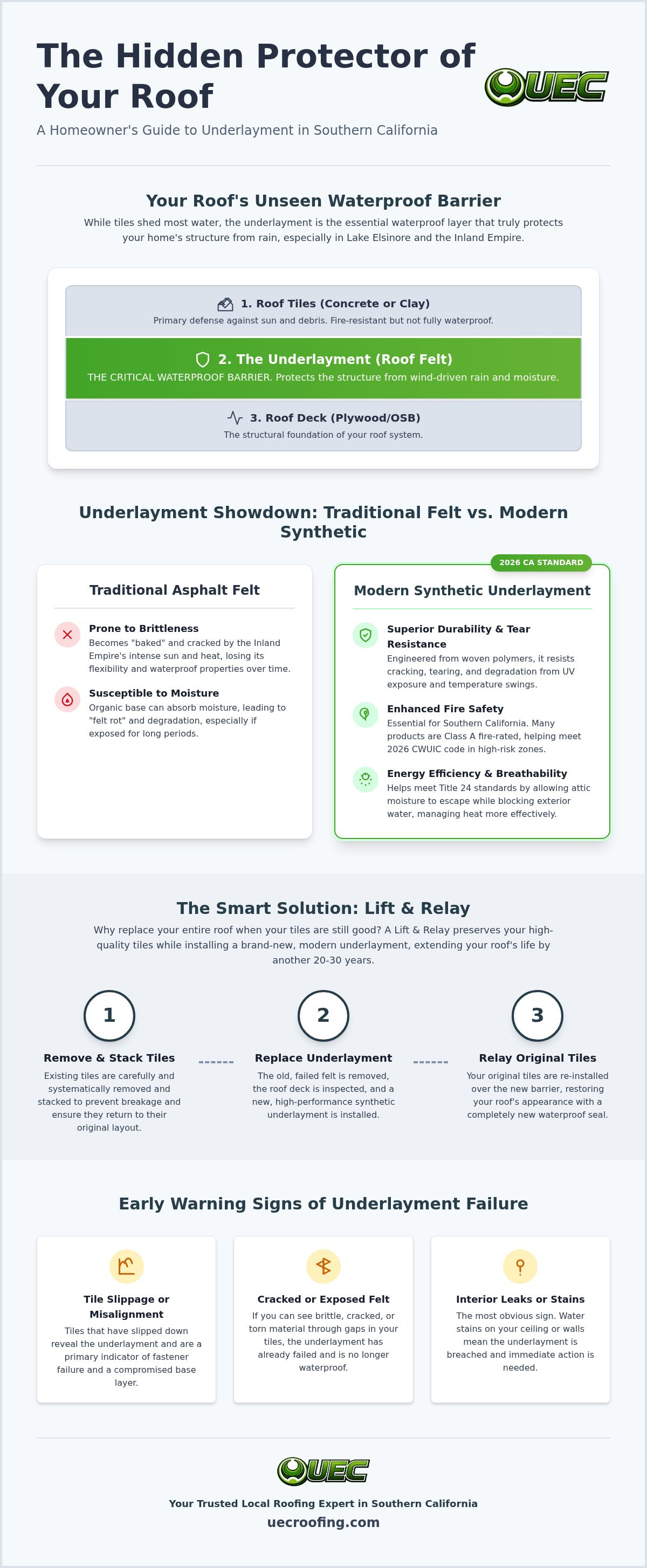
Your roof is more than just the shingles or tiles you see from the curb. While those materials provide the first line of defense, the true waterproof barrier is the underlayment, often referred to as roof felt. Historically, this layer was made of Tar paper, a heavy paper base saturated with asphalt. In the unique climate of Southern California, especially in areas like Lake Elsinore and the wider Inland Empire, the condition of this material determines whether your home stays dry during the winter rains. It's the silent protector of your rafters and ceiling.
For tile roofing systems common in Riverside and San Bernardino Counties, the tiles themselves are primarily decorative and fire-resistant. They shed the majority of water, but they aren't designed to be completely watertight. Wind-driven rain can easily migrate beneath the tiles. When this happens, you rely entirely on the underlayment to channel that water into the gutters. If the underlayment is brittle or torn, your interior drywall is the next stop for that moisture. Understanding the state of this hidden layer is the first step in evaluating your potential roof felt replacement cost. This investment ensures the structural integrity of your property for decades.
Felt vs. Synthetic Underlayment: Which is Better for 2026?
Traditional 30lb asphalt felt has served homeowners for decades, but modern synthetic options are rapidly becoming the standard. Synthetic underlayment is engineered from woven polymers, making it significantly more tear-resistant than organic felt. As of January 1, 2026, the California Wildland-Urban Interface Code (CWUIC) requires a full Class A fire-rated roof assembly in many high-risk zones. Many synthetic products now carry this rating, offering superior protection against embers. These materials also offer better breathability, allowing moisture from your attic to escape while preventing exterior water from entering.
- Superior Durability: Synthetics don't crack or become brittle like asphalt-based products.
- Fire Safety: Essential for compliance in Southern California's fire-prone canyons and hillsides.
- Energy Efficiency: Helps meet Title 24 standards by managing heat and moisture levels effectively.
Why Underlayment Fails in the Inland Empire
The Inland Empire's environment is harsh. Extreme temperature fluctuations cause constant expansion and contraction of the roof deck. Over time, traditional organic felt loses its elasticity and becomes "baked" by the relentless UV rays that penetrate through tile gaps. This leads to "felt rot" or extreme brittleness. When the Santa Ana winds kick up in Orange or Los Angeles Counties, they can shift tiles just enough to expose these weakened areas. Once the felt cracks, a single storm can cause significant interior damage. This degradation is why a professional inspection is necessary to determine if a lift and relay is the right path forward for your home.
The Lift and Relay Process: A Specialized Solution for Tile Roofs
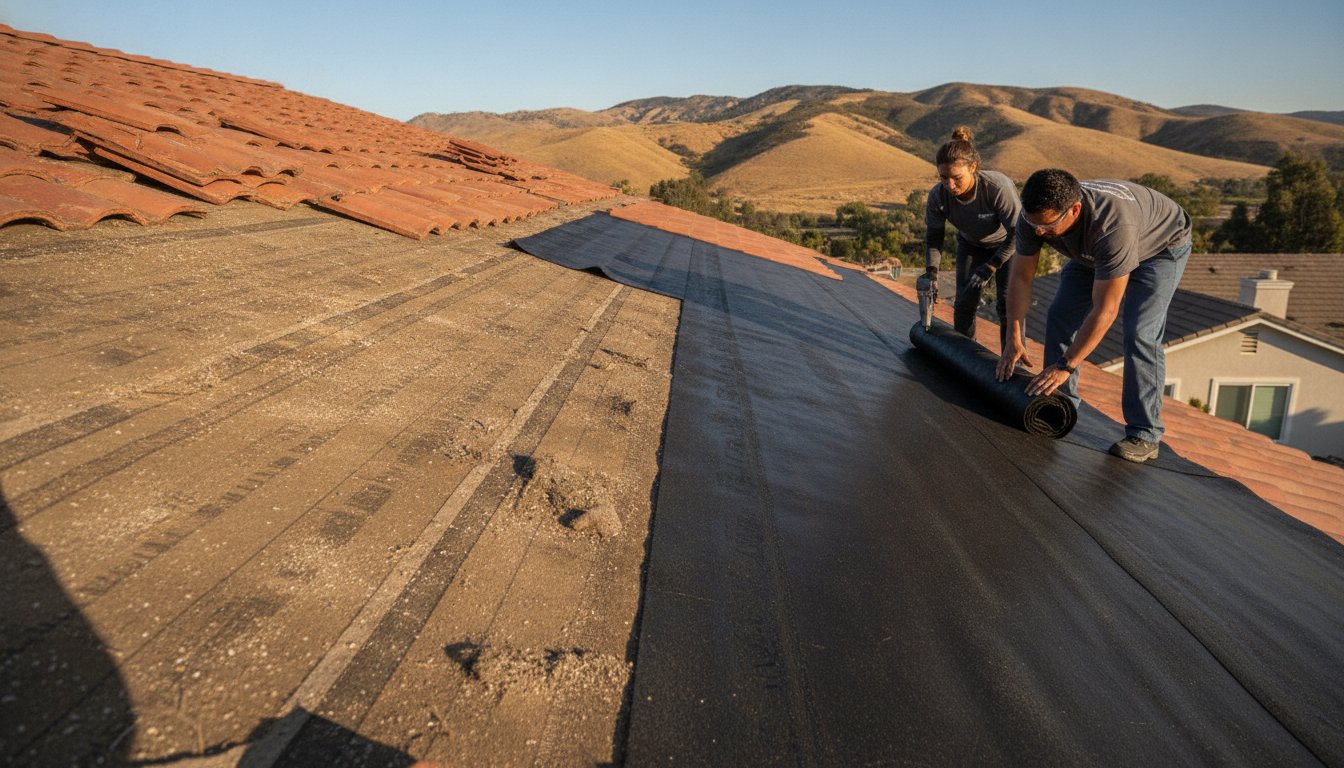
Many homeowners in the Inland Empire believe that a leaking tile roof requires a total, expensive replacement. This is a common misconception. In Southern California, your concrete or clay tiles are designed to last 50 years or more, but the felt underlayment typically fails much sooner. A "Lift and Relay" is a specialized service where we carefully remove your existing tiles, replace the failed waterproof barrier, and then reinstall the original tiles. It's a principled approach that preserves your high-quality materials while providing a brand-new seal for your home. This method can extend your roof's life by another 20 to 30 years.
Executing this process requires extreme technical precision. Tiles must be removed and stacked systematically to prevent breakage and ensure they return to their original layout. Professional contractors must adhere to strict California residential roofing regulations while working at heights to ensure both crew and property safety. For a deeper dive into the mechanics of this specialized work, read our Lift and Relay Roofing Service Guide. Homeowners often find that the roof felt replacement cost for a lift and relay is significantly more manageable than a full tear-off and new tile installation.
Step-by-Step: How a Professional Lift and Relay is Performed
We begin with a thorough inspection to evaluate the current state of your tiles and wood decking. Our team identifies any broken tiles and sources matching replacements to maintain your home's aesthetic. The process follows a methodical structure:
- Systematic Removal: Tiles are lifted and stacked on the roof or ground in a specific order.
- Decking Inspection: We strip the old, brittle felt and inspect the plywood for dry rot or water damage.
- Dual-Layer Installation: We install high-grade, dual-layer underlayment and new flashing to create a superior waterproof shield.
- Precision Relay: The original tiles are reinstalled, secured, and checked for proper alignment and drainage.
When to Choose Lift and Relay Over Full Replacement
The primary factor in choosing a lift and relay is the structural integrity of your current tiles. If your tiles aren't crumbling or severely pitted, there's no reason to discard them. This choice typically saves homeowners 40% to 60% compared to the cost of a full new tile installation. It's also the more sustainable option for Lake Elsinore residents, as it keeps thousands of pounds of functional material out of local landfills. If you're concerned about your roof's performance, a professional felt replacement assessment can determine if your tiles are candidates for this cost-effective solution.
Industry professionals across the Inland Empire measure roofing projects by the "square." This term represents a 100-square-foot area of your roof surface. When calculating your total roof felt replacement cost, we look at the number of squares involved alongside the specific material requirements for your home. In Southern California, labor and material standards typically sit 15% to 25% higher than the national average. This reflects the specialized expertise needed to handle the heavy tile systems common in Riverside and San Diego Counties, as well as the rigorous insurance and safety standards required in our region.
For a standard residential property, a tile "lift and relay" to replace the underlayment typically costs about half the price of a full tile roof replacement. This makes it an incredibly cost-effective way to secure a "new roof" result while keeping your existing tiles. While a simple tune-up might address a localized leak, it doesn't offer the comprehensive protection of a full refelt. Most homeowners find that investing in a complete system update is the best way to ensure long-term stability and protect their property value through 2026 and beyond.
Factors That Drive Your Roofing Estimate Up or Down
Your specific estimate depends on several variables that go beyond simple square footage. Accessibility is a primary driver. If a home is a single-story property with easy yard access, crews can stage materials and stack tiles much faster. A two-story home with a steep pitch requires more complex safety equipment and labor hours to ensure every tile is handled with care. We also evaluate the condition of your plywood deck. If the old felt failed long ago, we may find dry rot that requires repair before the new underlayment is installed. Additionally, material prices have seen shifts in 2026. Major manufacturers have increased underlayment prices by 5% to 8%, while metal components like flashing and valleys have seen increases of up to 15%.
Local Cost Variations: Riverside vs. San Diego vs. Orange County
Labor market trends in the Inland Empire remain competitive, but hiring a local expert provides a distinct advantage. Choosing a Lake Elsinore-based contractor often eliminates the long-distance travel fees that companies from Los Angeles or coastal Orange County might include in their bids. Permitting fees also create local variations. Depending on your city, such as Temecula or Anaheim, a roofing permit for a single-family home typically ranges from $150 to $600. Our team understands these local nuances and building codes, ensuring your project is compliant and efficient. By focusing on quality workmanship and principled pricing, we help you navigate these variables with confidence.
Homeowners often believe a roof is functional until water drips from the living room ceiling. In reality, interior stains are the final stage of a long failure process. Your roof sends quieter signals long before the drywall gets wet. One major red flag is tile slippage. When tiles shift out of alignment, it often means the fasteners have lost their grip because the underlayment beneath them has turned to dust. You should also check your gutters. Finding black granules or small, brittle "crumbs" of felt is a clear indicator that your secondary water barrier is disintegrating.
For a real-world look at how these issues escalate, see our Expert Roof Leak Repair Riverside CA case study. Catching these signs early is the only way to keep your roof felt replacement cost from ballooning into a full structural overhaul. Proactive maintenance is always more affordable than emergency restoration.
Visual Cues from the Ground and the Attic
Walk your property and look up. Do the tile rows look "wavy" or uneven? This suggests the underlayment is buckling or warping under the tiles. In the attic, use a flashlight to examine the rafters. Dark streaks, white efflorescence, or a persistent damp smell after a Santa Ana rain event are telltale signs of moisture penetration. You can also inspect the roof edges at the eaves or the rake. If the felt visible there looks like burnt crackers or snaps when touched, the rest of your roof is likely in the same brittle condition. These visual cues are your first line of defense against interior damage.
The "Age Factor" in Southern California
In the Inland Empire, standard organic felt has a predictable lifespan. Once it hits the 15 to 20 year "danger zone," the asphalt oils have usually evaporated due to our relentless UV exposure. Waiting for a catastrophic failure is a high-stakes gamble. A proactive roof felt replacement cost is an investment in your home's long-term stability. Ignoring these signs can lead to extensive deck rot and mold. That same project can quickly escalate from a manageable repair into a $25,000 full replacement if the structural wood fails. A professional roof repair inspection can determine exactly where your system stands before the next rainy season begins.
Why UEC Roofing is Your Long-Term Partner for Felt Replacement
Selecting a roofing contractor involves more than just comparing numbers on a page. It's about finding a partner who values your home's long-term stability as much as you do. At UEC Roofing, we've built our reputation as a "straight shooter" in the Inland Empire. We don't believe in high-pressure sales tactics or recommending a full tear-off when a specialized lift and relay will solve the problem. With over 2,000 successful projects completed across Southern California, our team brings deep technical expertise to every job site. Whether your home features traditional clay tile, modern composite shingles, or specialized metal systems, we understand the nuances of local building codes and environmental stressors. Our principled approach ensures you only pay for the services you actually need, providing total transparency regarding your roof felt replacement cost.
Our Commitment to Southern California Homeowners
We take immense pride in serving the diverse communities of Riverside, San Diego, Orange, and San Bernardino Counties. Our brick-and-mortar presence in Lake Elsinore allows us to respond quickly to local needs with the quiet confidence of a seasoned professional. We specialize in high-wind and fire-resistant roofing solutions, ensuring your home meets the rigorous 2026 California Wildland-Urban Interface standards. You can expect a clear, structured presentation of our professional standards and service offerings from the very first inquiry. We treat your roof as a critical investment, focusing on quality workmanship and ethical conduct to protect your property value for decades to come.
Protecting Your Investment with Preventative Care
Our goal is to be your "Roofer for Life," which means helping you avoid unnecessary expenses whenever possible. Often, a full replacement isn't the only path forward. Our specialized Roof Tune-Up Service can identify and fix minor issues before they compromise your underlayment. For roofs that are showing signs of age but are still structurally sound, we offer a detailed analysis of Roof Rejuvenation vs Replacement. These proactive measures can significantly delay a major roof felt replacement cost while keeping your home secure against the elements. We invite you to schedule a professional inspection today to discover the most honest and effective solution for your specific roofing needs.
Protecting Your Southern California Home for the Decades Ahead
Your roof's underlayment is the silent guardian of your home's structural integrity. As we've explored, maintaining this waterproof barrier is essential for navigating the extreme heat and seasonal rains of the Inland Empire. By choosing a specialized lift and relay, you can preserve your high-quality tiles while securing a brand-new seal. This approach ensures compliance with the latest 2026 building codes while keeping your roof felt replacement cost predictable and manageable.
With a track record of over 2,000 successful projects, UEC Roofing stands as the premier local expert for homeowners in Riverside and San Diego Counties. We pride ourselves on being straight shooters who prioritize long-term stability over temporary fixes. Don't wait for the next storm to test your roof's limits. Contact UEC Roofing today for a professional roof felt inspection and honest estimate. We're here to be your roofer for life, ensuring your family stays protected under a roof built to last.
Frequently Asked Questions
Is roof felt replacement covered by homeowners insurance in California?
Homeowners insurance in California typically covers roof felt replacement only if the damage results from a sudden, covered peril like fire or severe wind. Standard policies don't cover age-related wear and tear or gradual deterioration. If a Santa Ana wind event dislodges tiles and damages the underlayment, you may have a claim. However, if the felt has simply reached the end of its 20 year lifespan, the owner is usually responsible for the cost.
How long does a typical roof felt replacement take to complete?
A standard project for a 2,000 square foot home usually takes between three and five business days. The timeline depends heavily on the roof's complexity and the material type. A lift and relay for tile roofs requires more time because crews must carefully remove, stack, and reinstall the original tiles. Single-story homes in Lake Elsinore with easy access move faster than multi-story properties with steep pitches in the canyons of Orange County.
Can I replace just the felt on one section of my roof?
You can replace felt on a specific section, but it's often a temporary solution. California building codes include a "25% rule" stating that if you repair more than a quarter of the roof within a year, the entire system must meet current standards. In areas like Riverside or San Bernardino, it's usually more cost-effective to address the whole roof at once. This avoids mismatched materials and ensures your home has a consistent waterproof barrier.
What is the best time of year in Southern California to replace roof felt?
The best time for this work is late summer or early fall before the rainy season begins. While Southern California allows for roofing projects nearly year-round, scheduling during the dry months prevents interior water damage during the process. We also consider the Santa Ana wind patterns common in the Inland Empire. Completing your underlayment project in September or October ensures your home is fully sealed before the first major Pacific storms arrive in December.
Does a lift and relay service come with a new warranty?
Yes, a professional lift and relay service typically includes a warranty on both the workmanship and the new underlayment materials. While your original tiles remain, the new waterproof seal is backed by the contractor's performance guarantee. At UEC Roofing, we view ourselves as your roofer for life. This means we stand behind the integrity of our installations across San Diego and Riverside Counties, providing the peace of mind that your investment is protected.
What happens if I ignore brittle roof felt for another year?
Ignoring brittle felt often leads to expensive structural damage that far exceeds the initial project price. Brittle underlayment can't protect your plywood decking from moisture. Over time, this causes wood rot, mold growth, and compromised attic insulation. A single heavy rainstorm can result in interior ceiling failure. Proactive maintenance prevents a manageable repair from turning into a full emergency replacement that requires new wood and a much larger financial commitment.
How much does the type of underlayment material affect the total cost?
The choice between traditional organic felt and modern synthetic underlayment is a major factor in your total roof felt replacement cost. Synthetic materials generally carry a higher price point but offer superior tear resistance and fire ratings. As of 2026, many Southern California zones require Class A fire-rated assemblies. Investing in high-performance synthetic layers often provides better long-term value because these materials don't become brittle or rot as quickly as asphalt-saturated paper.
Will replacing my roof felt improve my home’s energy efficiency?
Replacing your underlayment can significantly improve energy efficiency by meeting California's Title 24 "cool roof" standards. Modern systems reflect more solar heat and manage attic moisture better than old, degraded felt. This reduces the load on your air conditioning during the intense Inland Empire summers. When combined with proper ventilation, a new underlayment helps maintain a stable indoor temperature, leading to lower utility bills and a more comfortable living environment for your family.