
How to Find a Roof Leak in Your Attic: A Moreno Valley Homeowner’s Guide
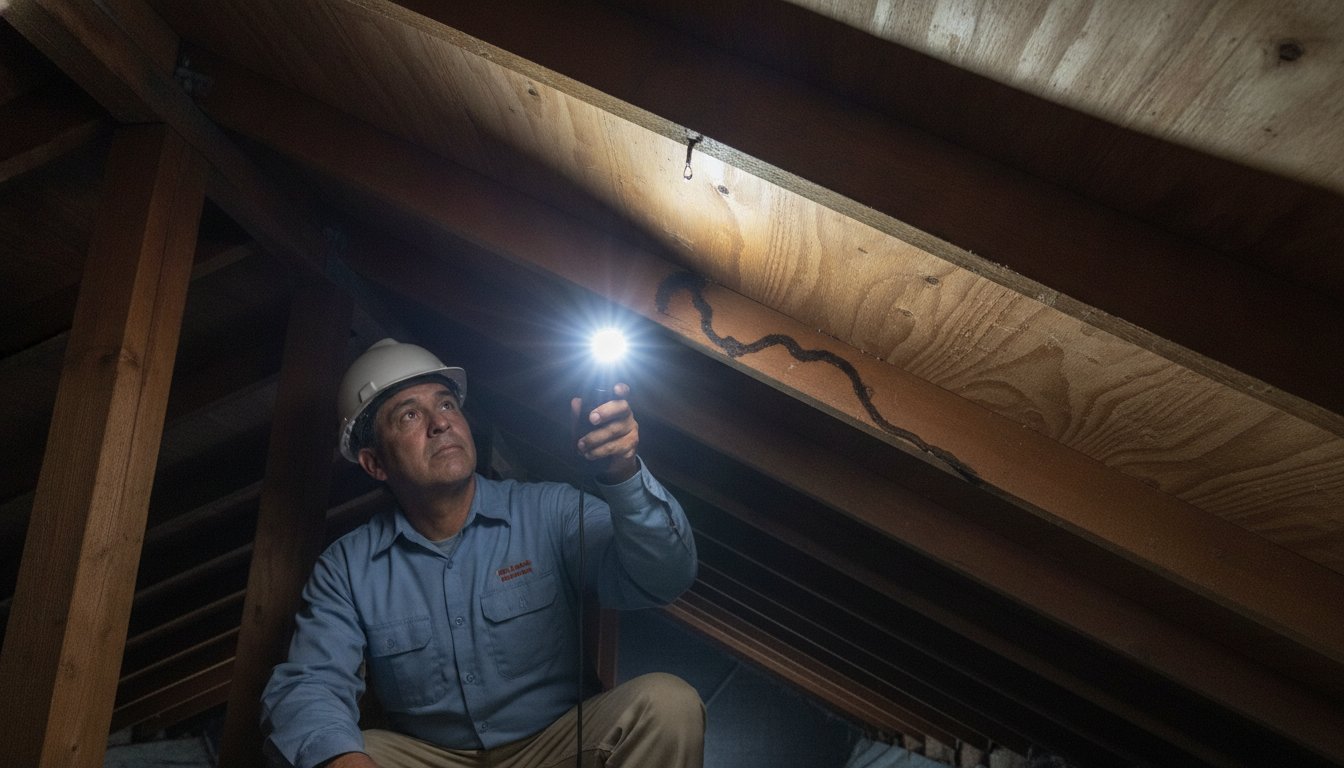
Did you know that the water stain on your bedroom ceiling is rarely located directly beneath the hole in your roof? In our unique Southern California climate, water often travels along rafters and underlayment for several feet before finally dripping onto your drywall. If you are currently finding a roof leak in my attic Moreno Valley, you're likely dealing with these "ghost paths" that make DIY detection a major headache. It's a stressful situation that can lead to hidden mold growth and rising repair costs if it's not addressed before the next Riverside County rainstorm hits.
We understand the anxiety that comes with a mysterious leak, especially when you're worried about the integrity of your home's tile or shingle system. This guide provides the professional techniques you need to safely pinpoint the source of moisture in your attic. You'll learn how to distinguish between a minor flashing issue and a failing felt underlayment, giving you the clarity to decide if a professional roof tune up is the right next step. We will walk through the specific tools you need and the safety protocols required to inspect your Moreno Valley home like a seasoned expert.
Key Takeaways
- Understand how the intense Inland Empire sun and thermal expansion create "ghost paths" that make leak detection different than in other regions.
- Learn the safest methods for finding a roof leak in my attic Moreno Valley by timing your inspection to avoid extreme afternoon heat.
- Discover how to trace "witness marks" like rusted nails or wood stains from your ceiling back to the actual entry point on the roof.
- Identify why broken tiles are often just a symptom and how compromised felt underlayment is the real culprit behind most local leaks.
- Gain the knowledge to document damage for insurance and understand when a simple repair or a professional "Lift and Relay" is necessary.
Why Finding a Roof Leak in Moreno Valley is Unique
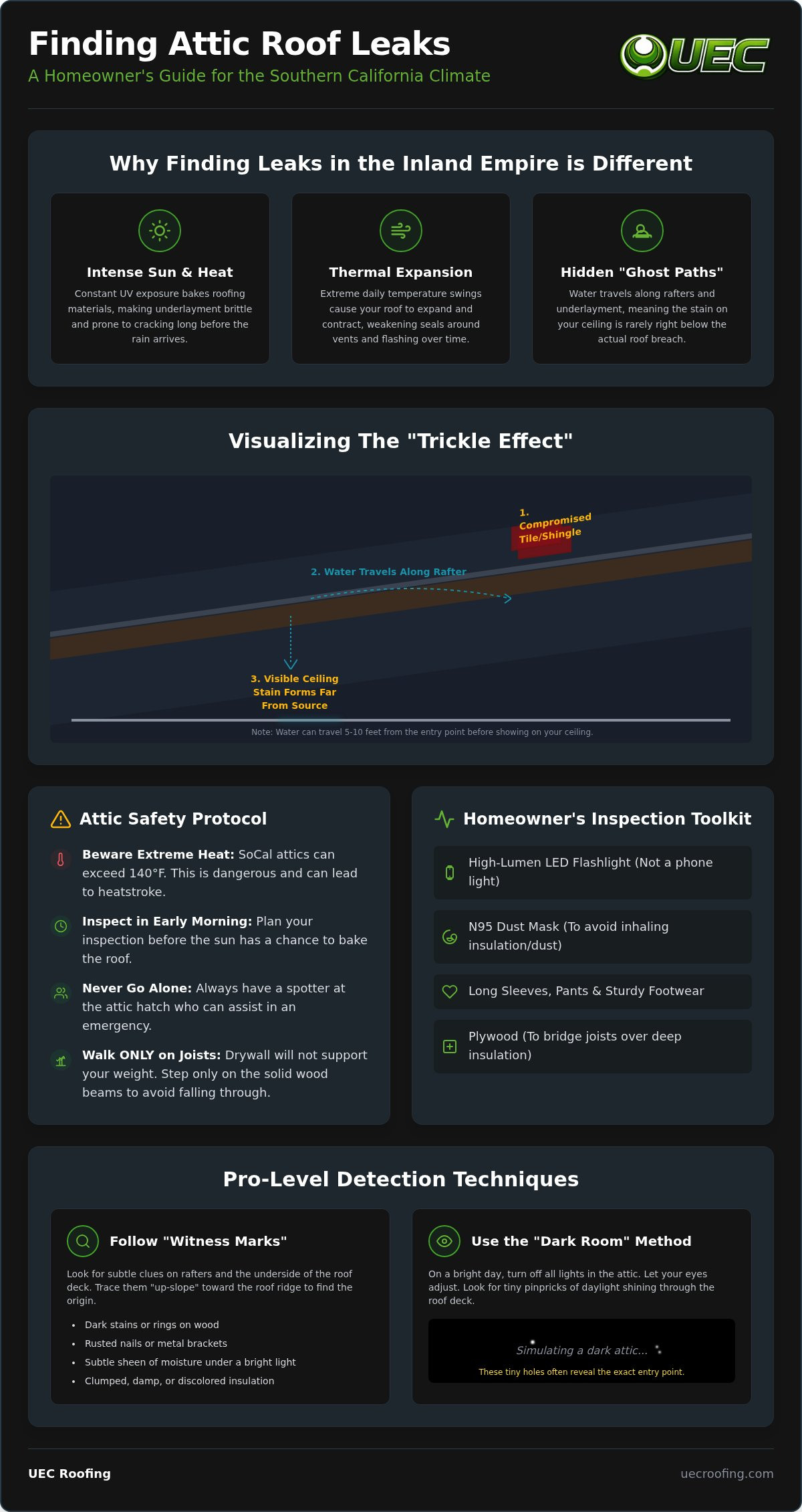
Moreno Valley presents a specific challenge for homeowners. Unlike wetter climates where moisture is constant, our region experiences extreme temperature swings. The high UV index in the Inland Empire constantly bakes roofing materials. During the day, your roof expands under the sun. At night, it cools and contracts. This cycle causes materials to shift and crack over time. When finding a roof leak in my attic Moreno Valley, you aren't just looking for a hole. You're looking for the cumulative result of years of environmental stress.
Our local weather patterns also play a role. Santa Ana winds don't just move air; they shift the very components of your roof. A tile that looks perfectly seated from the ground may have been rattled loose by 60-mph gusts. This creates a small gap that only accepts water during high-velocity rain. When a sudden Inland Empire flash flood arrives, it hits with intensity, testing every compromised seam in your system. This is why a leak often seems to appear out of nowhere after a long dry spell.
Sun vs. Rain: The Real Cause of SoCal Leaks
In Southern California, the sun is a more persistent enemy than the rain. Intense heat leaches the essential oils from asphalt shingles and the organic felt underlayment beneath tile roofs. This process forces materials into a "brittle phase." During long dry spells, the underlayment can crack or pull away from critical areas like roof flashing. These cracks remain invisible until the first major storm of the season. It’s a common paradox. Your summer heat is actually when most of your winter leaks are born.
Gravity and the 'Trickle Effect'
Water rarely takes the direct route. Once moisture penetrates your outer layer of shingles or tiles, it follows the path of least resistance. This is often along a rafter or the top of the underlayment itself. In Moreno Valley home construction, vaulted ceilings and complex rooflines create numerous channels for water to travel. Finding a roof leak in my attic Moreno Valley requires tracing these "witness marks" back to their origin. Consider these factors:
- Water can travel 5 to 10 feet away from the entry point before it ever drips onto your ceiling.
- Gravity pulls the water down-slope until it hits a gap in the insulation or a light fixture.
- A stain in your living room usually means the actual breach is several feet "up-slope" toward the ridge.
It's a methodical process of following the trickle back to the source. You have to think like water. If you only look at the spot directly above the stain, you'll likely miss the true cause of the damage.
Preparing for a Safe Attic Inspection in the Inland Empire
Safety is the primary concern when finding a roof leak in my attic Moreno Valley. Our local temperatures frequently climb into the triple digits during the summer months. In these conditions, an enclosed attic space can easily reach 140 degrees or higher. This level of heat is dangerous. Schedule your inspection for the early morning hours before the sun has a chance to bake your roof deck. This timing ensures you stay alert and focused on the task at hand.
Before you climb the ladder, gather the right equipment. Wear long sleeves, long pants, and sturdy, closed-toe footwear. You'll need a high-lumen LED flashlight. A standard phone light is simply insufficient for spotting the subtle sheen of moisture on dark rafters. Wear a N95 dust mask to avoid inhaling fiberglass insulation fibers or aged dust. Most importantly, never enter the attic alone. Always have a spotter standing at the hatch who can provide assistance if you lose your balance or feel overwhelmed by the heat.
Navigating the attic requires precision. Never step on the drywall or plaster between the wood beams. It will not hold your weight, and you will fall through the ceiling. Only walk on the solid ceiling joists. If the joists are buried under thick layers of blown-in insulation, use a piece of plywood as a temporary bridge to create a stable walking surface. Move slowly and maintain three points of contact whenever possible.
The Homeowner's Attic Inspection Toolkit
A professional-grade flashlight is your most valuable asset. It reveals "witness marks" that a dimmer light misses. If you're serious about finding a roof leak in my attic Moreno Valley, consider using a moisture meter. These devices detect dampness trapped deep within the insulation that might feel dry to the touch. Another expert trick is the "Dark Room" method. Turn off all flashlights during a bright Moreno Valley afternoon and look for tiny pinpricks of daylight shining through the roof deck. These often reveal exactly where shingles or tiles have failed.
Avoiding Common DIY Inspection Hazards
Older homes in Riverside County may contain insulation materials that cause severe skin and lung irritation. Don't touch these materials with bare hands. Be alert for signs of pests, as rodents often enter through the same gaps that allow water to penetrate your home. If you see droppings or chewed wires, proceed with caution. Watch for signs of heat exhaustion such as dizziness, heavy sweating, or nausea, and exit the attic immediately if you feel unwell. If the climb into the crawlspace feels too risky, a professional roof tune up can identify these issues safely and effectively.
Tracing the Path of Water Damage in Your Attic
Tracing the path of water requires a detective’s mindset. Once you’re safely in the attic, start directly above the visible ceiling stain. From there, your search must move vertically and "up-slope" toward the roof peak. Water follows gravity, but it also clings to rafters and sheathing. It often travels several feet from the actual breach before it finally drips onto your ceiling. This displacement is why many homeowners struggle to find the true source of a leak.
Look for "witness marks" that reveal the water’s journey. These include dark, tea-colored stains on the wood or black streaks running down the rafters. Rusted nails, often called "shiners," are another huge clue. These are nails that missed the rafter during construction; they become cold and attract condensation or catch traveling roof water. If you see wood that looks spongy or swollen, the leak has likely been active for several months. These signs are often more visible than the water itself.
If you are finding a roof leak in my attic Moreno Valley during the dry months, you might consider a "Garden Hose Test." This requires two people. One person stays in the attic with a high-lumen flashlight while the other gently sprays the roof with a garden hose. Start low, near the gutters, and move upward in sections. Don't use high pressure. You only want to simulate a steady Riverside rain, not a power wash. Stop immediately if you see water entering the attic to prevent flooding your insulation or damaging your drywall.
Identifying Fresh vs. Old Water Stains
Determining the age of a stain helps you understand the urgency of the repair. Use the "ring" test. A fresh leak often feels damp and has soft, bleeding edges. An old, inactive leak typically leaves a hard, crusty white or tan ring. In our Inland Empire heat, wood dries rapidly. This can make an active leak look old during the summer. Black streaks are a major red flag. They indicate that water has been penetrating the underlayment for a long time, which often leads to structural rot and mold growth.
Tracing Leaks Around Attic Penetrations
Most leaks occur where the roof is "penetrated" by vents, pipes, or skylights. Inspect the base of HVAC vents and plumbing stacks. If the rubber boots are cracked from UV exposure, water will seep down the pipe directly into your attic. Skylights are particularly common leak sources in Moreno Valley. The intense sun causes the seals to expand and contract until they fail. If you find moisture near these areas, it's time to look into Expert Roof Leak Repair in Riverside CA to ensure your home remains protected.
Common Moreno Valley Roof Failure Points to Check
After you have identified moisture trails in the attic, you must turn your attention to the exterior. Finding a roof leak in my attic Moreno Valley often reveals that the problem isn't where you expect. For example, a cracked tile on a Mediterranean-style home might look like the obvious culprit. In reality, that tile is just a protective shell. The true failure usually lies deeper within the system's layers.
Shingle roofs in Riverside County face different stressors. The relentless sun causes shingles to lose their protective granules over time. When these granules wash away, the asphalt mat is exposed to direct UV rays. This leads to "cupping" or "curling" at the edges. These deformed shingles allow water to blow underneath during our heavy seasonal storms. If you see "bald" spots on your shingles from the ground, your attic is likely already at risk.
Flashings and gutters are the final pieces of the puzzle. Flashings are the metal transitions around chimneys, vents, and valleys. They are the most common point of failure for any roof in the Inland Empire. Similarly, gutters filled with debris cause water to back up under the eave's edge. This backup pushes moisture directly into your attic space through the soffit vents or under the first course of roofing.
The Hidden Danger of Failed Underlayment
Think of your roof tiles as armor and the felt underlayment as the actual waterproofer. In many established Moreno Valley neighborhoods, the original organic felt has reached its 20-year limit. It becomes brittle, paper-thin, and eventually cracks. Once the underlayment fails, water seeps through even if every tile is perfectly in place. This is where a Lift and Relay Roofing Service becomes essential. It preserves your existing tiles while replacing the failed waterproofing layer beneath them to ensure long-term protection.
Wind Damage and 'Scoured' Shingles
Santa Ana winds are a major factor in regional roof failure. High-velocity gusts lift shingle tabs and break the factory sealant bond. Once that bond is broken, the shingles "scour" or flap in the wind. This allows wind-driven rain to push horizontally under the roofing material. If you see damp insulation near the eaves or perimeter of your attic, wind-driven rain is the likely cause. Preventative maintenance is always more cost-effective than reactive repairs. If you have spotted these signs of wear, it is time to contact a professional roofing contractor to secure your home before the next Riverside County storm.
From Detection to Professional Roof Repair in Moreno Valley
After you have finished finding a roof leak in my attic Moreno Valley, the focus shifts to professional resolution. Your initial discovery is the foundation for a successful repair. Take clear photographs of the water stains, rusted nails, or damp insulation you found. These images provide essential context for your contractor and serve as a record for insurance purposes. Clear documentation ensures that no detail is overlooked during the restoration process.
If another Inland Empire storm is approaching, you may need temporary mitigation. A heavy-duty tarp secured with sandbags can prevent immediate water intrusion. Avoid using "quick-fix" hardware store sealants on your tiles or shingles. These products often bake and crack under the intense Riverside County sun, creating a mess that complicates permanent repairs. A tarp is a dependable stop-gap, but it is not a substitute for professional craftsmanship.
We take a "straight shooter" approach to every inspection. Our goal is to protect your family and your property value, not to sell you a roof you don't need. We prioritize repairs and maintenance whenever possible. If your roof has structural integrity, we focus on targeted solutions that address the root cause of the leak rather than recommending a premature replacement.
Repair, Rejuvenate, or Replace?
Every roof has a distinct lifespan influenced by its exposure to the elements. We evaluate the remaining life of your shingles or tiles to determine the most ethical path forward. Roof rejuvenation is often a viable alternative to replacement. This process can save Moreno Valley homeowners thousands of dollars while adding years of durability to an aging system. Before committing to a major investment, consider a professional Roof Tune-Up Service to identify if your system is a candidate for rejuvenation.
Choosing a Local Moreno Valley Expert
Hiring a contractor with deep Inland Empire experience is vital. A local expert understands how Santa Ana winds and thermal expansion specifically impact Moreno Valley homes. Our team brings a methodical, thorough approach to every inspection, ensuring your attic remains dry and your underlayment stays secure. UEC Roofing has completed over 2,000 successful projects in the region, establishing a reputation for honesty and craftsmanship. We are a brick-and-mortar business based in Lake Elsinore, and we treat every client’s home with the respect it deserves. When you choose a local specialist, you are choosing long-term stability and peace of mind.
Securing Your Moreno Valley Home Against Hidden Water Damage
Identifying the source of an attic leak is the first step toward preserving your home’s structural integrity. By understanding the unique way water travels across Inland Empire rafters and recognizing the signs of aged underlayment, you can act before minor drips become major repairs. Safety remains paramount. If finding a roof leak in my attic Moreno Valley feels overwhelming or the afternoon heat is too intense, don't risk your well-being on a steep roof or in a cramped crawlspace.
Our team at UEC Roofing brings the expertise of over 2,000 successful Southern California projects to every inspection. As local Lake Elsinore experts specialized in Tile Lift and Relay services, we provide the honest, transparent advice you need to make an informed decision. Whether your roof requires a simple tune up or a more comprehensive repair, we are here to ensure your investment is protected for years to come. Contact UEC Roofing for a Professional Leak Inspection in Moreno Valley today and gain the peace of mind you deserve.
Frequently Asked Questions
How do I find a roof leak in the attic if it's not raining?
You can find a leak by searching for dry indicators like water rings or "shiners," which are rusted nails. Use a high-lumen flashlight to spot dark streaks on rafters or white mineral deposits on the wood. The "Dark Room" method is also effective on sunny days to find light gaps. This is a reliable way of finding a roof leak in my attic Moreno Valley without waiting for a storm.
Is it safe to walk in my attic to look for a leak?
It's only safe if you strictly walk on the wooden ceiling joists. Drywall and insulation cannot support your weight and you will fall through the ceiling. In the Inland Empire, heat exhaustion is a serious risk for anyone in a crawlspace. Always have a spotter standing at the hatch and only enter the attic during the cool morning hours to stay safe and alert.
How much does it typically cost to fix a roof leak in Moreno Valley?
Repair costs vary significantly based on the roof material and the complexity of the breach. Tile roof repairs typically involve more labor-intensive steps than asphalt shingle fixes. Other factors like the age of the underlying felt and the proximity to valleys or chimneys also influence the final cost. We focus on providing transparent estimates that prioritize long-term durability and quality craftsmanship over quick, temporary fixes.
Can a roof leak cause mold in my attic?
Yes, mold can develop within 24 to 48 hours of water exposure. The high temperatures in Southern California attics create a natural greenhouse effect that accelerates fungal growth in damp insulation. This can quickly damage your home's air quality and compromise the structural integrity of your lumber. Addressing moisture immediately is the only way to prevent a costly and extensive mold remediation project later.
Should I use a tarp if I find a leak during a storm?
Tarps provide excellent temporary protection if you discover a leak during a Riverside County rainstorm. Secure the tarp with weighted sandbags rather than nails to avoid creating new holes in your shingles or tiles. Never climb onto a wet or slippery roof while it is raining. It is much safer to wait for clear weather or contact a professional for emergency tarping and inspection services.
What are the most common causes of roof leaks in Moreno Valley?
Most regional issues stem from UV-damaged felt underlayment or Santa Ana winds that lift shingle tabs. Finding a roof leak in my attic Moreno Valley often reveals cracked flashing around vents, skylights, or chimneys. These metal components expand and contract in our extreme heat until the waterproof seals eventually fail. Clogged gutters can also force water backward under your eaves during flash floods.
How can I tell if I need a roof repair or a full replacement?
If the damage is localized to one area, a targeted repair or a "Lift and Relay" for tile roofs is usually sufficient. A full replacement is only necessary if the entire underlayment system has reached the end of its functional life. We take a "straight shooter" approach, recommending rejuvenation and repairs whenever possible to help you maximize the value and longevity of your current roof.
Does homeowners insurance cover roof leak repairs in Riverside County?
Coverage typically depends on whether the leak was caused by a "sudden and accidental" event like a storm. Gradual leaks caused by a lack of maintenance are rarely covered by standard policies. If you live in a Fire Hazard Severity Zone in Riverside County, your roof must also meet the latest Class A fire-rated standards to remain compliant with 2026 building codes and insurance requirements.