
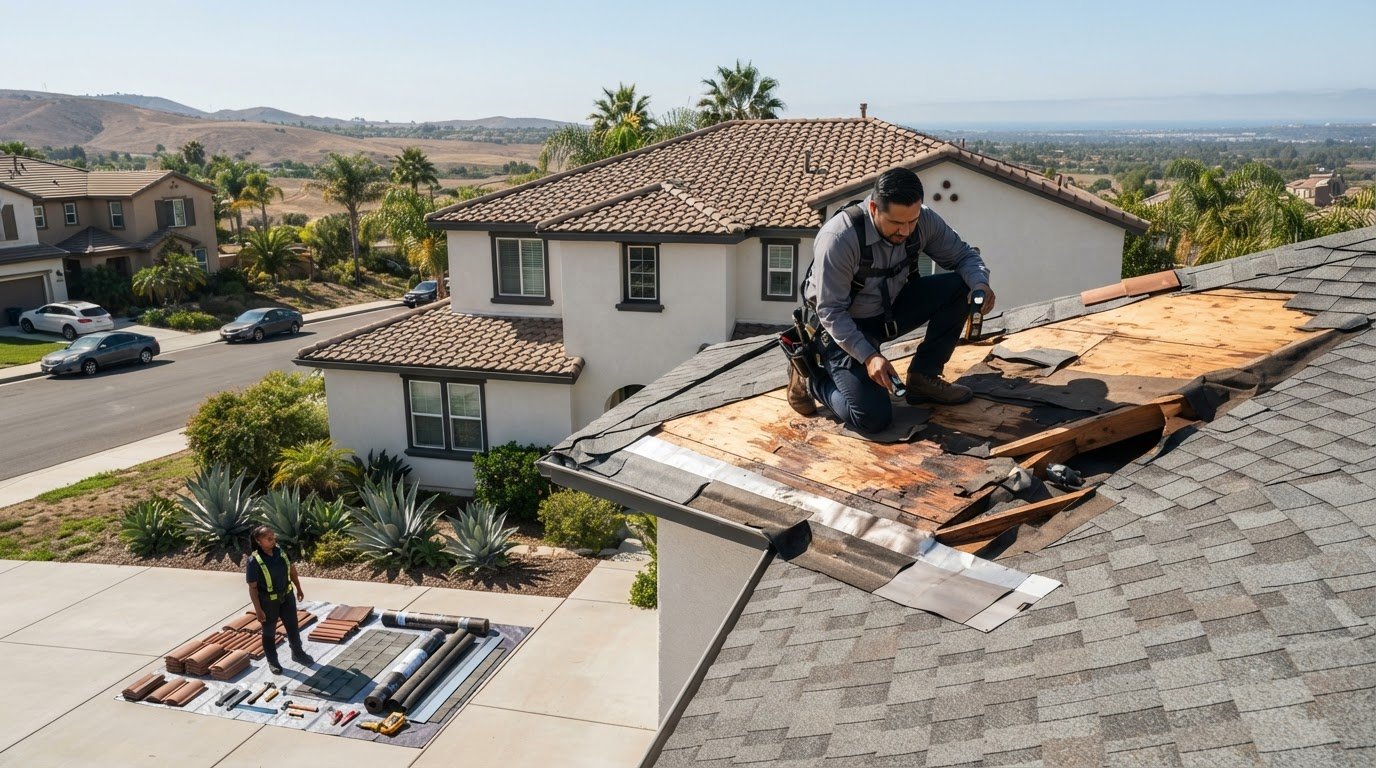
What if two roof repair estimates differ because they describe different work, not just different prices? In Southern California, roofing repair prices depend on what is happening beneath a visible leak, the roof material, and how much of the system needs attention. A ceiling stain may point to a focused repair, or it may reveal a broader problem that needs a closer assessment.
Before deciding what to do, look for an estimate that connects the observed issue to a defined repair scope and explains why that approach suits your home. This guide breaks down the details that shape an assessment, including roof condition, material, access, and possible concealed damage.
You’ll also learn how to compare repair options without relying on broad national averages, and what information can make an inspection more useful. In Lake Elsinore and the Inland Empire, as in Riverside, Orange, and San Diego, local roof conditions matter. The goal is a clearly explained repair plan that protects your home and supports the roof’s long-term performance.
Key Takeaways
- Roofing repair prices depend on the diagnosed issue, roof material, slope, access, and repair location.
- Roof tiles, felt, flashing, and water entry points can all affect the work identified during an inspection.
- Repair, tune-up, rejuvenation, and replacement suit different roof conditions and involve different scopes of work.
- Review an estimate by separating observed conditions and defined tasks from possible additional findings.
- A local assessment connects your Southern California roof’s condition with a practical next step.
What Shapes Roofing Repair Prices in Southern California?
There isn’t one figure that describes every roof repair. Roofing repair prices depend on what an inspection identifies and the work needed to address it, not simply the home’s size or a broad regional average. A useful estimate connects the observed condition to a defined scope, so you can see what the work addresses and why.
Material, roof pitch, height, access, and repair location all affect how a job is planned. Reaching a leak near a roof edge may involve different work than addressing a concern around a roof opening or across a section of tile. Repair methods also vary by system. Tile, composite shingle, metal, foam, and flat roofs have different construction details. This overview of roofing material types and their properties provides context for why repair methods depend on the roof itself.
How damage type and repair area affect an estimate
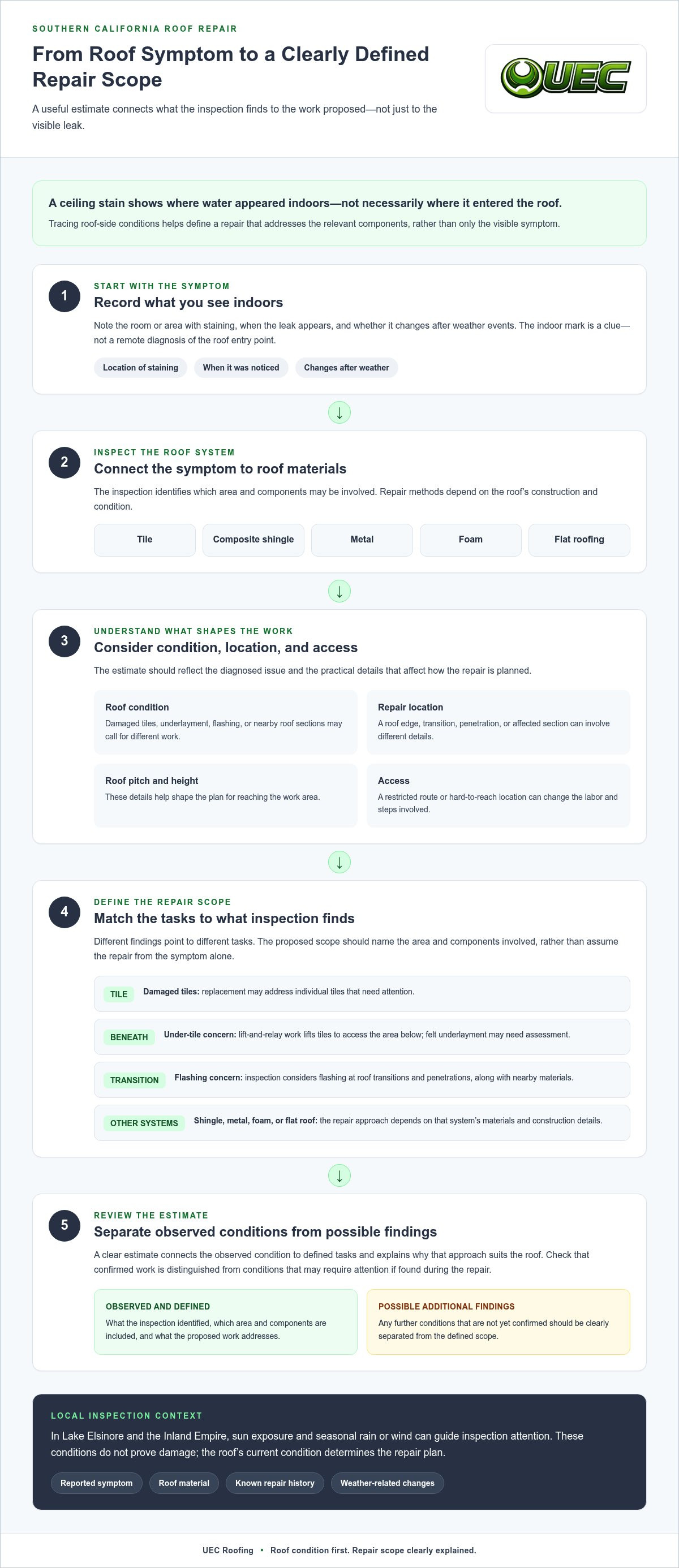
A localized leak may call for focused work, while inspection findings could point to underlayment, flashing, or nearby roof sections that also need attention. The visible ceiling stain shows where water appeared indoors, but not necessarily where it entered the roof. Locating the entry point helps define work that addresses the relevant roofing components, rather than only the visible symptom.
Why roof access and local conditions matter
Roof pitch, height, and the route to the work area affect how a repair is planned. Restricted access or a hard-to-reach location can change the labor and steps involved. Those details belong in the project assessment because they help explain the proposed scope, even when the visible problem seems small.
In Lake Elsinore, Riverside, and the wider Inland Empire, sun exposure and seasonal rain or wind are relevant inspection context. They don’t prove that a roof has been damaged. Instead, they help guide attention to the roof’s current condition and areas connected to a reported concern. Make an assessment more useful by noting when a leak appears, which room shows staining, and whether the issue changes after weather events.
- Identify the reported symptom and its indoor location.
- Describe the roof material and any known repair history.
- Check that the proposed scope distinguishes the visible issue from other conditions found during inspection.
These details make an estimate more useful than a generic per-roof figure. It should explain how the diagnosed condition, material, and access shape the repair plan for your Southern California home.
Which Southern California Roof Repair Details Change the Work?
A ceiling mark or drip can look straightforward, but the work depends on what an inspection finds. Water may travel from its entry point before it becomes visible indoors. A leak’s visible location shows where water appeared, not necessarily where it entered the roof. Tracing the roof-side conditions helps define the repair instead of relying on the indoor symptom alone.
This section explains what can shape repair work, not a price list or a substitute for an on-site assessment. Roofing repair prices are difficult to evaluate without knowing which roof components are involved and what the inspection shows. For broader regional context, the Southern California roofing industry offers a local reference point. A project assessment identifies conditions specific to your roof.
Tile, felt, and flashing repairs
On a tile roof, replacing a damaged tile is different from lift-and-relay work. Tile replacement addresses individual tiles that need attention. Lift and relay involves lifting tiles to access the area beneath them. If an inspection indicates that the felt underlayment needs replacement, that work may be part of the defined scope. The right approach depends on the condition found, not just the fact that the roof is tile.
Flashing also deserves attention at roof transitions and around penetrations. Its condition and relationship to nearby materials can help explain where water may be entering. A stain near a wall or roof opening isn’t enough to diagnose a flashing problem remotely. An inspection helps determine whether flashing, felt, tile, or another part of the roof is involved.
Leak repairs across different roof systems
UEC Roofing assesses leak repairs across tile, composite shingle, metal, foam, and flat roofing. Each system has its own materials and construction details, so a method suited to one roof may not fit another. The inspection connects the reported leak with the roof’s construction and the conditions at the affected area.
For example, a leak on a tile roof may require looking beneath the tile surface, while a concern on a composite shingle roof calls for assessing the affected shingles and surrounding area. Metal, foam, and flat roofs also need an approach suited to their respective systems. These are possibilities, not diagnoses. A visible symptom alone can’t establish the scope.
To make an assessment more informative, note where you see interior staining, when you first noticed it, and whether it has changed. Share any known roof repair history, too. UEC Roofing can assess the roof and define a repair scope based on its condition. Request a roof repair assessment to understand what work your Southern California roof may need.
Repair, Tune-Up, Rejuvenation, or Replacement: Which Scope Fits?
A roof assessment should match the proposed work to the roof’s actual condition. A localized, addressable issue may call for a repair, while broader wear or multiple concerns can point to a different scope. This makes roofing repair prices easier to evaluate: first understand what work is proposed and why, then consider the estimate in context.
| Option | Condition to assess | Intended work | Useful assessment question |
|---|---|---|---|
| Repair | A specific, localized concern that inspection finds can be addressed | Work on the affected roof area or components | What condition was found, and which parts of the roof are included? |
| Tune-up | Maintenance needs identified during an inspection | Roof maintenance, not a substitute for every needed repair | Which maintenance items are included, and are separate repairs needed? |
| Rejuvenation | An aging roof assessed as eligible for this approach | Roof rejuvenation suited to the roof’s condition | Why is this roof a candidate, and what should I understand about the proposed work? |
| Replacement | Condition that calls for a broader roofing solution | A new roof rather than work limited to an existing area | What inspection findings support replacing the roof? |
When a focused repair or tune-up may fit
A focused repair may make sense when an inspection identifies a limited problem and defines work for the affected area. The roof’s overall condition still matters. A tune-up is different: it addresses maintenance concerns identified during an assessment, but it shouldn’t be treated as a cure-all for a leak or a substitute for needed repair work.
Ask how the proposed scope relates to the inspection findings. If both repair and maintenance are recommended, the estimate should make their roles clear. This helps distinguish work intended to address a specific issue from broader upkeep.
When rejuvenation or replacement deserves consideration
Rejuvenation may be considered for an aging roof assessed as eligible, but it isn’t interchangeable with a repair or a new roof. It also shouldn’t be presented as a guaranteed extension of service life. Replacement is a broader project for a roof whose condition calls for that scope. The decision should follow inspection findings, not a fixed age or percentage rule.
For a deeper discussion, UEC Roofing’s Roof Rejuvenation vs Replacement guide can help frame the comparison. Ask what conditions support the recommendation, what work is included, and how the proposed scope differs from the alternatives. Those answers help you evaluate whether the plan fits your roof instead of relying on a general rule.
How to Review a Roofing Repair Estimate Before Work Begins
A clear repair estimate should explain the path from the reported issue to the proposed work. It should distinguish what the inspection found from work that might be needed only if additional conditions are uncovered. That distinction makes roofing repair prices easier to assess in context, without treating a broad estimate as a substitute for a roof-specific explanation.
- Reported issue: Check that it reflects the concern you described, such as a leak or visible damage.
- Observed conditions: Look for what the assessment found and which roof area or components are involved.
- Repair scope: Confirm that the proposed tasks are described clearly enough to understand what work is planned.
- Materials: Check that the estimate identifies the material or roof component relevant to the repair, where applicable.
- Follow-up: See how the estimate explains conditional work or additional findings that could change the scope.
What a clear repair scope should explain
The estimate should identify the affected roof area and describe the proposed repair in terms you can follow. It should separate observed conditions from repair tasks, and defined work from conditional work that may depend on further findings. If a line is unclear, ask what condition it addresses and how it relates to the reported issue. A thorough explanation helps you understand the plan without implying a guaranteed result, timeline, or outcome.
For example, an inspection might note a condition in one area while separately describing repair work proposed there. The finding and the task are related, but they aren’t the same. A clear scope lets you see which conditions are documented and which tasks are included. UEC Roofing’s Roof Tune-Up Service guide also offers preventative maintenance context, which can help distinguish routine upkeep from a defined repair need.
What to document before and after an assessment
Before the assessment, write down when you first noticed the issue, where signs appear indoors or outdoors, and whether anything changed after recent weather. Safe, ground-level photographs can show visible conditions without putting you at risk. Don’t walk on the roof or disturb damaged materials to gather more information.
After the assessment, keep the estimate and any notes together. Compare the reported issue with the documented findings, proposed tasks, materials, and conditional work. If the scope changes after additional conditions are identified, ask for a clear explanation of what was found and how it affects the work. Keeping a record makes decisions easier and helps ground the repair plan in the roof’s actual condition.
For a project-specific roof repair assessment in Southern California, contact UEC Roofing about your roof.
Get a Local Roof Repair Assessment from UEC Roofing
A repair recommendation should reflect the roof in front of you, not a generic description of Southern California homes. UEC Roofing serves homeowners in Menifee, Temecula, Lake Elsinore, Canyon Lake, Corona, Anaheim, Moreno Valley, Winchester, Wildomar, Murrieta, Riverside, Orange, Huntington Beach, Fallbrook, Vista, Escondido, Carlsbad, San Diego, El Cajon, and Poway.
Local conditions help put a roof concern in context. A visible leak, displaced tile, or other sign of trouble is a reason to assess the roof, not proof that one particular repair is needed. An inspection can connect the reported concern to observed conditions and help define a practical scope for your home. That gives you a better basis for understanding roofing repair prices than a broad range without project details.
Roof repair services for Southern California homes
UEC Roofing provides roof repair services including leak repair, tile replacement, felt replacement, lift and relay, and roof tune-ups. Each option serves a different purpose. A repair addresses a defined issue, while a tune-up focuses on maintenance needs. Tile or felt work and lift and relay may be considered when inspection findings point to those parts of a roof system.
The right recommendation depends on the roof’s observed condition and your needs. The assessment should make clear what was found, what work is proposed, and how that work relates to the concern. A well-maintained roof plays an important role in protecting your home and preserving property value, so decisions are best grounded in the roof’s condition rather than assumptions based on a symptom alone.
A clear next step for your roof
Before requesting an assessment, note when you first noticed the issue and where signs appear. Describe any ceiling marks, roof concerns you can see safely from the ground, or changes you noticed after rain or wind. If you know about previous roof work, sharing that history can provide useful context. You don’t need to diagnose the cause yourself. Keep clear of the roof and let the assessment determine which components need attention.
Whether you’re dealing with a leak, concerned about tile or felt, or looking for a roof tune-up, a project-specific assessment can clarify the next step. UEC Roofing’s recommendations are shaped by the roof and the work it needs.
Contact UEC Roofing for a roof assessment.
Make Your Next Roofing Decision with Clarity
Your roof helps protect your home and the value you’ve worked to build. Treating an assessment as part of ongoing home care, rather than a one-time transaction, can make future decisions more considered. A brief record of inspections, maintenance, and repairs gives you a useful reference as Southern California seasons bring changing conditions. Regular attention can help you plan thoughtfully instead of letting a concern dictate your next step.
Roofing repair prices belong in that context: the estimate matters, but so does understanding what it addresses and how the recommended work fits your roof’s condition. Take time to understand the proposed next step, then choose an approach that supports your home over time.
Move forward with a locally grounded assessment and a roofing partner focused on long-term care. Arrange a roof assessment with UEC Roofing and take the next step with greater confidence.
Frequently Asked Questions
How much do roofing repairs cost in Southern California?
There isn’t one price that applies to every repair. Roofing repair prices should reflect a defined project scope, not a universal figure for a home or region. When reviewing an estimate, focus on the work it describes and whether any items are conditional. That gives you a more useful basis for understanding the proposed amount than a broad average.
Is roof repair covered by homeowners insurance?
Coverage depends on your policy, the circumstances of the damage, and your insurer’s decision. A roof assessment can document observed conditions, but it can’t determine whether a claim will be accepted. Keep your claim reference number and insurer correspondence with your project records. If anything about the claim process or required documents is unclear, ask your insurer directly, since its instructions and policy terms govern the claim.
Can a roof leak cause damage before stains appear?
Yes. Water can affect concealed parts of a roof assembly before it becomes visible on a ceiling. Don’t treat the absence of a stain as proof that a reported leak has stopped or that the roof is unaffected. If you notice a drip or dampness, keep people clear of the area if needed and arrange an assessment. Avoid climbing onto the roof to investigate.
Does roof repair require a permit in Southern California?
It depends on the proposed work and the local jurisdiction. Before work begins, describe the repair scope to the building department responsible for your property and ask what current requirements apply. A small repair and work that changes more of the roofing system may be treated differently, so don’t rely on a rule of thumb from another city or project. Keep relevant project records together.
How long does a roof repair usually take?
There isn’t one timeframe for every repair. The expected work period depends on the scope, conditions at the roof, weather, and any additional findings. Ask how the schedule relates to the listed tasks and what could change it. It can also help to clarify whether the estimate describes on-site work or the broader project schedule, so expectations are clear before work begins.
Can a tile roof be repaired without replacing the whole roof?
Yes, a tile roof can sometimes be repaired without replacing the entire roof. The assessment should establish whether the concern can be addressed in a limited area or whether findings point to a broader need. After the work, keep the repair record with your home maintenance documents. That history can help provide context for future assessments and maintenance decisions.
What should I document before reporting roof damage to insurance?
Along with noting when you first became aware of the concern, keep your policy details, claim reference number, and a record of communications with your insurer. Save inspection findings and repair paperwork as the claim progresses. Follow the insurer’s instructions for submitting information, since documentation requirements can differ. Don’t climb onto the roof or disturb materials to gather evidence.
For a roof assessment or repair, contact UEC Roofing and describe the concern you’ve noticed so the team can help identify a practical next step.