
Why Is My New Roof Leaking in San Diego? Causes and Next Steps
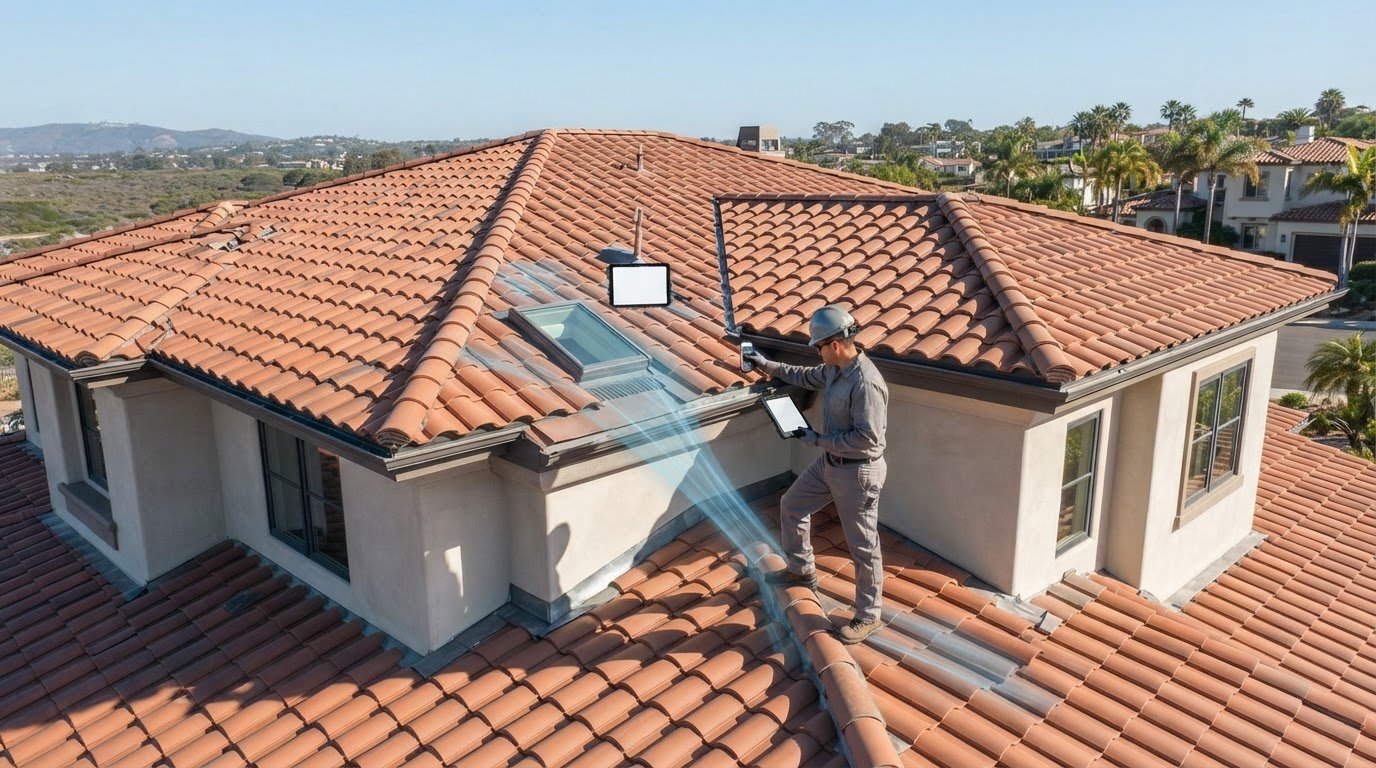
If you’re searching “why is my new roof leaking San Diego,” a ceiling stain or drip soon after installation can be alarming. The stain may be far from the point where water entered, and it doesn’t automatically mean the entire roof needs replacement. Water can travel beneath roofing materials before becoming visible indoors.
It’s reasonable to expect a new roof to keep your home dry. Finding the cause takes careful diagnosis, not guesswork. This guide covers roof details that can contribute to leaks, ways to record useful clues without climbing onto the roof, and what to document before arranging an assessment. Depending on the findings, the right next step may be a focused leak repair, tile or felt replacement, or broader work. Conditions can vary between coastal San Diego and inland communities, so the assessment should account for the specific roof and where the moisture appears.
Key Takeaways
- To understand why your new roof is leaking in San Diego, compare signs of roof-detail problems with clues pointing to another nearby system or indoor moisture.
- Flashing, roof penetrations, underlayment, drainage, and transitions are details to examine. A visible clue alone doesn’t establish the cause.
- Record when the leak appears, the weather, affected rooms, and any changes you observe. Keep installation paperwork and related communications together.
- The right next step depends on the findings, from targeted leak repair to tile or felt replacement.
Why a New Roof Can Leak in San Diego
A new roof should protect your home and the property beneath it. When water appears indoors after reroofing, concern is understandable. The useful first step is to identify where water may be entering and how it reached the affected area, rather than assume the whole roofing system has failed.
A leak that appears after installation is a reason to investigate, not proof that the entire roof has failed. Flashing, roof penetrations, underlayment, drainage, and transitions between roof sections are all possible areas to examine. The timing is useful information, but it doesn’t identify the source or establish what caused the leak.
Water can enter at one detail and travel before it becomes visible. The types of roofs and their components vary, and the way those parts meet can help explain how a small, localized opening may lead to an interior stain or drip.
Which roof details can allow water into a recently reroofed home?
Flashing helps direct water around features such as walls, vents, and chimneys. Where roof surfaces meet a wall or change direction, the transition needs to manage water as it flows across the roof. These details are worth examining if water is not being directed away as intended, but an interior stain alone can’t confirm a flashing problem.
On a tile roof, a displaced or damaged tile may expose the protective layer beneath it. Underlayment, roof penetrations, and transitions may also be relevant. These are possibilities, not diagnoses. An assessment can examine how the details connect and whether visible conditions align with the reported leak.
Why San Diego rain and roof exposure matter
Wind-driven rain can reach roof details differently from rain falling straight onto a surface. A leak may become noticeable during a particular storm even if the roof appeared dry in ordinary conditions. Record whether wind accompanied the rain, but treat that timing as a clue rather than proof of where water entered.
Roof design, slope, drainage, and exposure vary from one property to another across San Diego County and Southern California. Roof shape affects how water moves toward edges, valleys, and transitions. An assessment should consider the home’s layout and the conditions around the leak instead of assuming every roof responds to rain in the same way.
Drainage is another useful consideration. Water needs a clear path off the roof; areas where it collects or moves slowly may help focus the investigation. That doesn’t prove drainage caused the leak, but it is one condition to compare with the water’s likely path. The goal is to connect observable roof conditions with the symptoms and choose a response supported by the findings.
How to Trace a New-Roof Leak Without Guessing
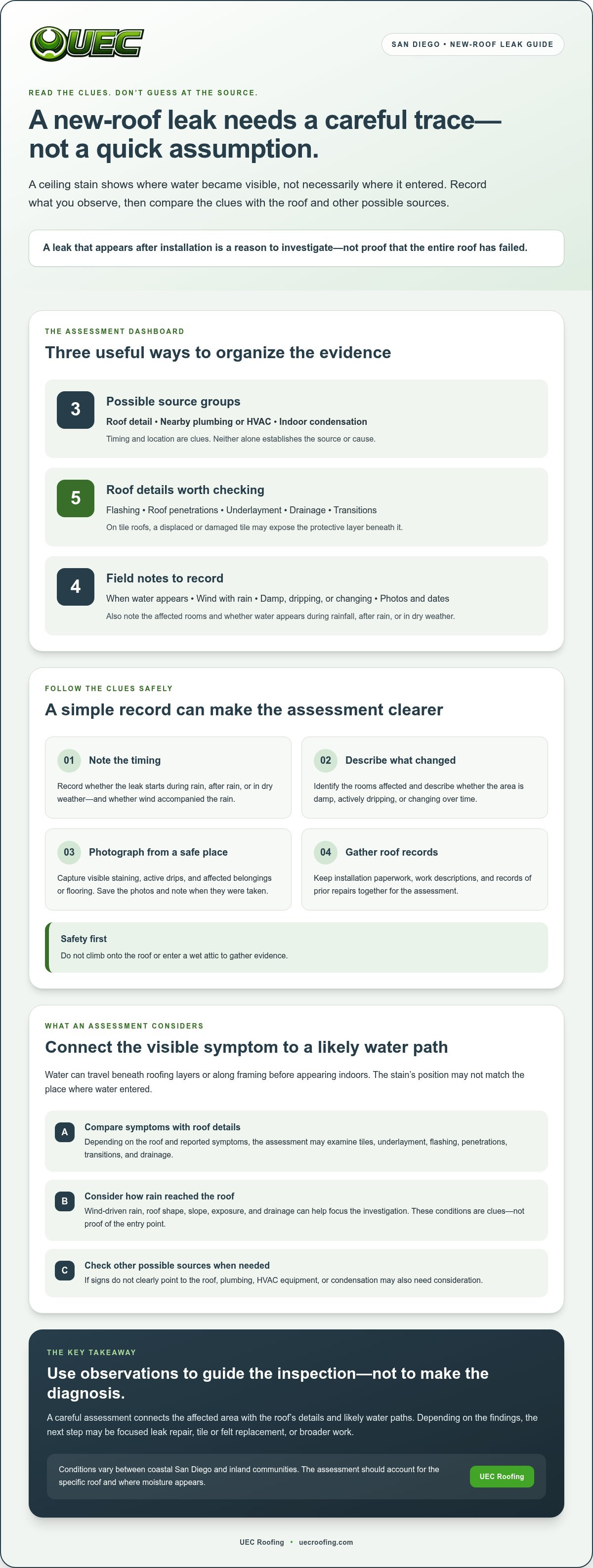
A useful leak assessment starts with a clear record, not a guess based on the ceiling stain. Note when you first saw water, what the weather was like, and which rooms or surfaces are affected. These details help compare the timing and location of symptoms with roof conditions and other possible sources.
What to record before an inspection
Keep observations simple and specific. From a safe location, photograph visible staining, active drips, and affected belongings or flooring. Don’t climb onto the roof or enter a wet attic to gather evidence. Keep installation paperwork, work descriptions, and records of prior repairs together so they’re available during the assessment.
- Note whether water appears during rainfall, after rain, or in dry weather.
- Record whether wind accompanies the rain and which rooms show signs of moisture.
- Describe whether the area is damp, actively dripping, or changing over time.
- Save clear photos and record the dates you took them.
This record can help answer “why is my new roof leaking San Diego” without treating one clue as a diagnosis. A stain near a roof feature is useful context, but it can’t establish that the feature is the entry point.
How a professional inspection follows the water path
Water can move along framing or beneath roofing layers before reaching an interior surface. The ceiling stain marks where water became visible, not necessarily where it entered the roof. Matching a stain’s position to the roof directly above it may therefore lead to the wrong conclusion.
A professional assessment considers the affected room alongside relevant roof details. Depending on the roof and reported symptoms, it may include checking tiles, underlayment, flashing, penetrations, transitions, and drainage. If the signs don’t clearly point to the roof, plumbing, HVAC equipment, or condensation may also need consideration. A photograph can document what you see, but it can’t reliably distinguish among these sources on its own.
Access and conditions matter. A visual check may reveal useful evidence, while some situations call for a closer look. A careful assessment explains what was observed and which next step the findings support. UEC Roofing handles leak repair by focusing on the affected area and likely water paths. If you’re seeing signs of a leak, contact UEC Roofing about leak repair rather than rely on a photo or guess.
Is It an Installation Issue, Another Roof Detail, or a Different Leak?
A leak that appears after reroofing deserves a careful assessment, but timing alone doesn’t establish its cause or the repair needed. The source could be a roof detail, a nearby plumbing or HVAC component, or moisture forming indoors. Use observed patterns as clues, not as a final diagnosis.
Possible source
Clues to observe
What they can’t prove
Inspection focus
Roof detail
Moisture appears during or after rain, particularly near a roof-to-wall transition or below a roof feature.
The location and timing don’t prove that the nearest roof detail is the entry point or that installation caused the leak.
Assess relevant flashing, penetrations, valleys, roof layers, and drainage.
Adjacent system
The leak appears around plumbing, HVAC equipment, or a related ceiling area, possibly without a clear connection to rainfall.
A nearby pipe or unit doesn’t automatically mean it’s the source.
Compare the interior signs with the location and condition of nearby systems.
Interior moisture
Dampness or staining appears without an obvious rain-related pattern.
A dry-weather symptom alone can’t confirm condensation or rule out a roof issue.
Consider indoor moisture conditions alongside roof and building evidence.
Clues that may point toward a roofing detail
A stain below a valley, roof penetration, or wall transition can help direct an assessment, especially if it appears after rain. Flashing and underlayment are important to consider because they help manage water at roof connections and beneath the outer surface. Relevant details differ among tile, shingle, metal, foam, and flat-roof assemblies. A clue narrows the focus; it doesn’t confirm a defect.
When water may come from beyond the roof surface
Plumbing, HVAC equipment, and condensation are reasonable alternatives to consider when they’re near the affected area or when the timing doesn’t fit rainfall. Compare indoor and exterior evidence before deciding that roof work is needed. Don’t climb onto a steep, wet, or otherwise unsafe roof to investigate. UEC Roofing provides roof leak repair in Riverside and across its Southern California service area.
That comparison helps keep the next step proportional to the evidence. A roof-related finding may call for focused repair, while signs pointing elsewhere require a different assessment. The presence of a new roof matters to the investigation, but it isn’t proof of fault or a reason to assume the whole roofing system needs replacement.
What San Diego Homeowners Should Do After Finding a New-Roof Leak
Start by keeping people away from active leaks and any ceiling that looks swollen or unstable. If water is close to a light, outlet, or other electrical equipment, don’t touch the area or nearby switches. Move belongings only if it’s safe, and use a container to catch drips where practical. Don’t cut into a ceiling or attempt a roof patch yourself.
How to document the leak and installation history
As you limit interior damage, make a brief note of what you did, such as moving furniture or placing a container beneath a drip. This helps distinguish the original conditions from changes made to protect the room. Keep the account factual, and avoid removing wet building materials before the affected area has been assessed. Share the information with the roofing professional evaluating the leak.
How to think about repair options
Let the findings guide the scope. A localized issue may call for focused leak repair; evidence involving damaged tiles or felt may point to tile replacement or felt replacement. If the assessment identifies concerns across a wider portion of the roof, broader work may be appropriate. Don’t assume full replacement is needed from the appearance of an interior stain alone.
A useful recommendation explains what condition was found, how it relates to the leak, and why the proposed work addresses it. If wider work is indicated, consider the roof’s overall condition and the specific assessment findings before deciding on a path forward.
For a clear assessment of a San Diego roof leak, contact UEC Roofing about roof leak repair. The findings can help you protect your home and choose work that fits the roof’s actual needs.
How UEC Roofing Can Assess a New-Roof Leak in San Diego
A new-roof leak calls for a clear explanation of what the evidence shows and which next steps make sense. UEC Roofing starts with the affected area and the conditions you’ve observed, then considers likely water paths and relevant roof details. The goal is to understand the issue before recommending a repair, rather than assume a visible stain calls for extensive work.
A repair plan based on the roof’s actual condition
An assessment should distinguish a localized concern from signs that may involve a wider part of the roofing system. On a tile roof, findings may support tile replacement. If the protective felt needs attention, felt replacement may be appropriate. Other findings may call for focused leak repair. The right scope depends on the roof’s condition and what the assessment reveals.
A recommendation should connect the proposed work to the observed issue. A concern in one area doesn’t automatically mean the entire roof needs replacement, while a broader problem deserves an appropriate evaluation. The findings can clarify what was observed and why a particular repair path fits the roof.
Local roofing support across Southern California
UEC Roofing serves San Diego and communities across Southern California, including Menifee, Temecula, Lake Elsinore, Canyon Lake, Corona, Anaheim, Moreno Valley, Winchester, Wildomar, Murrieta, Riverside, Orange, Huntington Beach, Fallbrook, Vista, Escondido, Carlsbad, El Cajon, and Poway. The company provides leak repair, tile replacement, felt replacement, roof tune-ups, and roof rejuvenation services.
For homeowners, a local roofing partner can help explain the roof’s condition and the work that fits. UEC Roofing focuses on leak repair and related roofing services, keeping the response tied to the home’s needs and the assessment findings.
If you’re still asking why a new roof is leaking in San Diego, UEC Roofing can assess the reported issue and discuss appropriate next steps. Build a relationship with a dependable roofing partner, a roofer for life. Contact UEC Roofing about your San Diego roof leak.
Move Forward With a Clear Roofing Plan
A leak in a newly installed roof can shake your confidence, but uncertainty doesn’t have to shape your next decision. Focus on getting a clear assessment before deciding how much work the roof needs. A measured plan can help protect your home while keeping the response tied to what the findings show.
Bring your observations and installation records to the conversation, and ask for a straightforward explanation of the findings and recommended next steps. You deserve to understand the reasoning behind the proposed work, without pressure to make assumptions about the entire roof.
UEC Roofing can help you move from concern to a practical path forward. Contact UEC Roofing to discuss roof leak repair for your San Diego home.
Frequently Asked Questions
Can a brand-new roof leak during the first rain?
Yes. The first rain can reveal a leak, but the timing alone doesn’t identify its source. Note when moisture first appears during the weather event and whether the affected area changes afterward. That timeline gives an assessor more useful context than simply recording that the roof leaked.
Does a new roof leak always mean the installation was done incorrectly?
No. A leak by itself doesn’t establish responsibility or prove that the installation was incorrect. The assessment should identify the observed condition and explain how it relates to the leak. Keep conclusions separate from observations until the findings support a clear explanation.
Can water enter around roof vents or other penetrations after reroofing?
Yes, roof penetrations are among the details an assessment may examine. Tell the roofing professional which features are near the affected area, but don’t assume proximity proves the cause. The key is whether the findings connect that roof detail to the reported symptoms.
Can a ceiling stain appear far from the point where roof water entered?
Yes. The visible stain may not be directly below the entry point. Identify the room and describe the stain’s position relative to fixed features, such as a doorway or exterior wall. That gives the assessor a precise indoor reference without guessing where the water entered.
Could plumbing or an air-conditioning system look like a roof leak?
Yes. Plumbing or air-conditioning equipment can also be associated with indoor moisture. If either is near the affected area, mention its location and any relevant observations during the assessment. Comparing that information with roof conditions helps determine which source, if any, is supported by the evidence.
Should I climb onto my roof to find the leak?
No. Leave roof access to a professional, especially if the surface is wet, steep, or unfamiliar. You can still provide useful context from indoors or the ground by noting where moisture appears and what conditions were present. Don’t move or disturb roof materials while investigating.
What records should I keep when a new roof starts leaking?
Keep the installation paperwork, work description, dated photos, and any related communications together. These records provide project history and context for the assessment. Describe what you observed in neutral terms, and don’t treat paperwork or a photograph as proof of the leak’s cause.