
Choosing a Family-Owned Roofing Company in San Diego: A Homeowner’s Guide
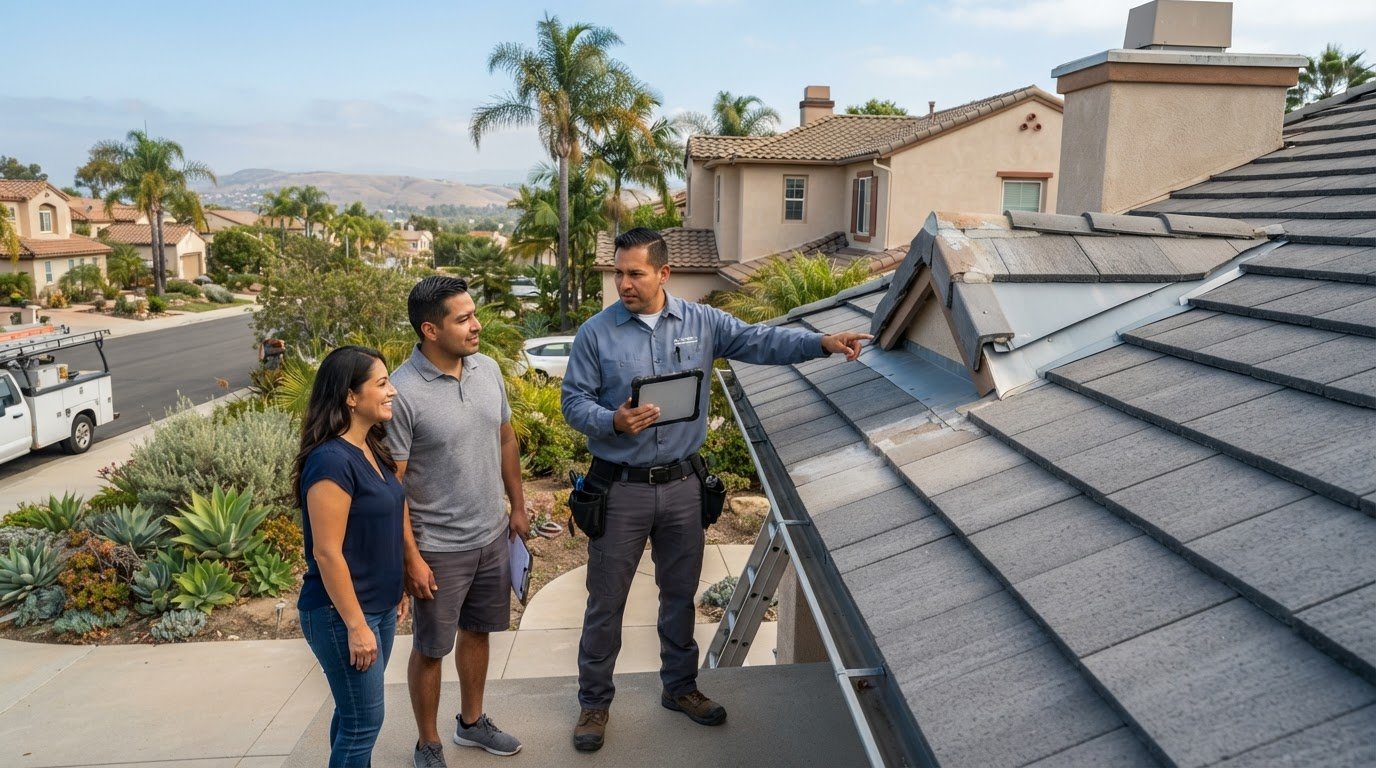
What if a company’s family name tells you less about its roofing work than the inspection and estimate in front of you? Choosing a family-owned roofing company San Diego homeowners can rely on starts with verifying the ownership claim, then checking whether the inspection, recommended work, and written proposal fit the roof.
It’s reasonable to want a roofer who understands the differences between coastal conditions and hotter inland neighborhoods. It’s just as important to identify whether your roof needs a repair, maintenance, or replacement, rather than agreeing to work that goes beyond its condition. Estimates are difficult to compare when inspection details and recommended work aren’t clear.
This guide offers a practical checklist for checking ownership, local experience, services, and communication before you hire. You’ll learn how to compare inspection findings and proposals, assess whether the contractor’s services fit your roof, and ask useful questions about scope and next steps. Family ownership can be a meaningful trust signal, but it should be confirmed, not assumed. The right fit comes from clear evidence, suitable work, and a proposal you understand.
Key Takeaways
- Verify that a family-owned roofing company San Diego homeowners are considering is actually family-owned. “Privately owned” doesn’t by itself confirm family ownership.
- Ask for inspection findings and recommended work in plain language, then check that the proposed services suit your roof’s material and condition.
- Compare proposals side by side, including scope, materials, repair areas, exclusions, and next steps. Resolve differences in inspection findings before weighing the estimates.
- Consider your property’s location and roof conditions when assessing a contractor’s regional experience, from San Diego to Lake Elsinore and the Inland Empire.
- Before choosing UEC Roofing, review the inspection and proposal, confirm the service fits your needs, and clarify questions about the work.
What “Family-Owned Roofing Company in San Diego” Should Mean to a Homeowner
A family-owned roofing company is a business owned and operated by members of the same family. For homeowners, that description is an ownership claim to confirm, not proof of good workmanship or the right fit for a particular roof. A company can be privately owned without being family-owned, so ask what the business means when it uses the label. For a general overview of what a family-owned business means, consider how ownership and family involvement can take different forms.
Choosing a family-owned roofing company San Diego residents can trust still requires looking beyond ownership. The inspection should explain what the contractor observed, the recommended work should match the roof’s condition, and the proposal should make the scope clear. A familiar local name can be reassuring, but it doesn’t replace evidence of relevant roofing experience, clear communication, and suitable services.
How can you verify a roofer is family-owned?
Start with a direct question: “Who owns and operates the company, and how long has the current ownership been in place?” Then review the company’s own website and materials. If the wording is unclear, ask a representative to explain it. Look for a consistent answer, but treat ownership as one trust factor alongside the inspection and proposal.
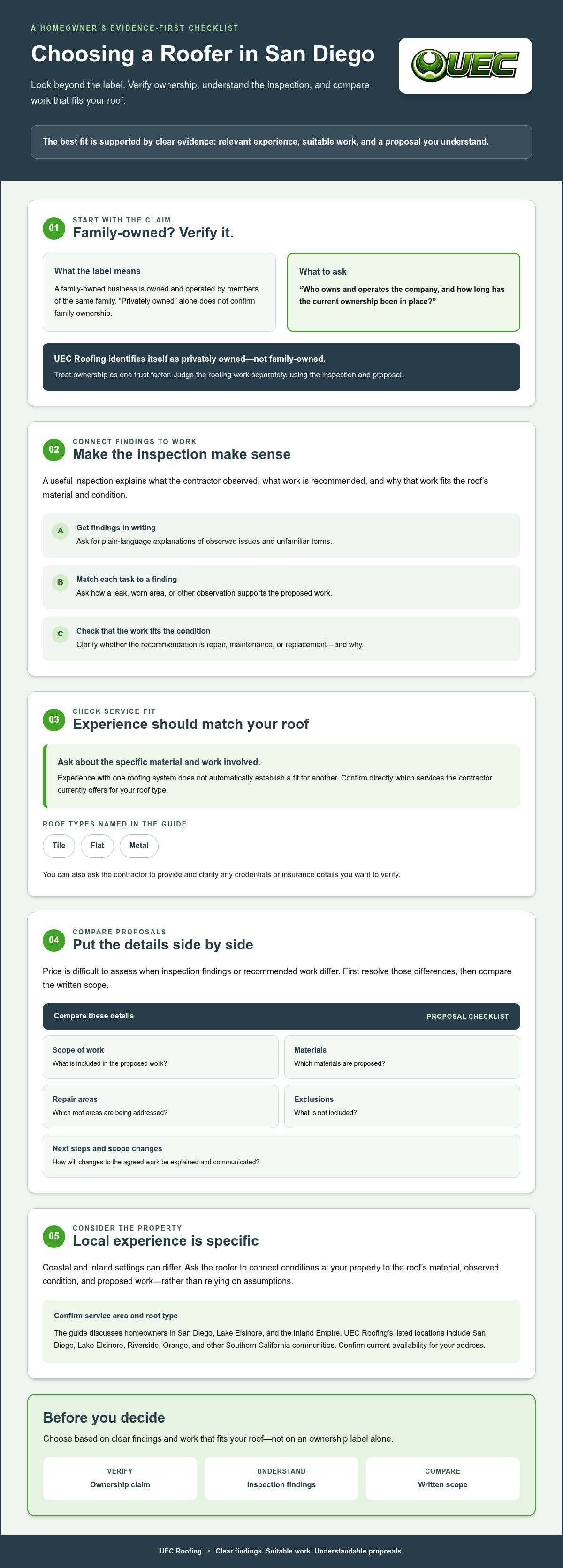
Keep the distinction clear. UEC Roofing’s company information identifies it as privately owned, not family-owned. Don’t apply the family-owned label without direct confirmation. The same standard applies to any contractor: verify the claim before relying on it, then judge the roofing work on its own merits.
Why local knowledge matters in San Diego County
“Local experience” is most useful when a contractor can explain how conditions at your specific property relate to the roof’s material and observed condition. Coastal and inland settings can differ, but assumptions about the home aren’t a substitute for an inspection. Ask the roofer to connect each finding to the proposed work and explain relevant considerations in plain language.
Homeowners comparing options in San Diego, Lake Elsinore, and the Inland Empire should also confirm that the contractor currently serves their address and roof type. UEC Roofing’s listed locations include Menifee, Temecula, Lake Elsinore, Canyon Lake, Corona, Anaheim, Moreno Valley, Winchester, Wildomar, Murrieta, Riverside, Orange, Huntington Beach, Fallbrook, Vista, Escondido, Carlsbad, San Diego, El Cajon, and Poway. Confirm current availability for your property, then base your decision on clear findings and work that fits the roof.
How to Evaluate a San Diego Roofer’s Experience, Services, and Standards
A useful roof inspection should leave you with a clear understanding of what the contractor observed, what work they recommend, and why. Ask for findings in writing and request plain-language explanations of unfamiliar terms. If the roofer identifies a leak or worn area, ask how that finding supports the recommended repair, maintenance, or replacement. You should be able to connect each proposed task to an issue on your roof.
Roofing experience is most relevant when it matches your home’s material and the work being considered. A contractor familiar with tile may not be the right fit for every flat or metal roofing project. Ask about experience with your roof type, and check directly which services the company currently offers for your system. The National Roofing Contractors Association can provide general roofing information, but you should separately ask each contractor to provide and clarify any credentials or insurance details you want to verify.
Questions to ask before hiring a roofing contractor
Before choosing a family-owned roofing company San Diego homeowners should ask focused questions about the inspection and how the work will be managed. For example:
- Who will assess the roof, and how will you document the findings?
- What work is included, what is excluded, and which materials are proposed?
- How will you explain and communicate any changes to the agreed scope?
- What experience do you have with this roof material and this type of work?
- How do the proposed repairs, ventilation considerations, and maintenance recommendations relate to this roof’s condition and expected longevity?
Clear answers make it easier to understand the proposal and identify questions to resolve before work begins. If an answer is vague, ask for a specific example from the inspection or request that the detail be added to the written scope.
Match the roofer’s services to your roof
Different findings can point to different options. Depending on the roof and the inspection, ask whether repair, felt replacement, tile replacement, or lift and relay is appropriate. You can also ask whether a roof tune-up, rejuvenation, or new roof best fits the observed condition. A recommendation should explain why the option suits your roof, rather than treating every concern as a reason for the same scope of work.
For metal, foam, composite shingle, or flat roofs, confirm the contractor’s current service availability for your specific system and property. UEC Roofing’s stated services include roof repair, felt and tile replacement, lift and relay, rejuvenation, and new roof installation. To review its roofing services, compare the listed work with your inspection findings and confirm details directly with the team.
How to Compare Roofing Proposals Without Choosing on Price Alone
A roofing proposal is only useful to compare if you understand what each contractor is recommending. Two estimates may look similar while covering different repair areas, materials, or next steps. Before weighing the totals, compare the written scope and resolve differences in what the contractors observed during their inspections. Don’t assume two quotes cover identical work.
What should a roofing proposal explain?
Look for a clear description of the work area, proposed repair or replacement, and materials. When relevant, check how the proposal addresses felt, tile, ventilation, and cleanup. Ask the contractor to explain unclear exclusions, assumptions, or responsibilities assigned to you. If an item isn’t specified, request written clarification rather than filling in the gap yourself.
To make the review practical, set up a simple comparison table with one column for each proposal and rows for:
- Inspection findings and areas of the roof involved
- Recommended work, including repair or replacement
- Materials and any felt, tile, or ventilation work listed
- Exclusions, assumptions, and homeowner responsibilities
- Who will communicate updates and the stated next steps
Mark each item as included, excluded, unclear, or not applicable. This makes differences visible without treating an incomplete proposal as equivalent to a detailed one. If a contractor recommends replacement while another proposes repair, ask both to explain how their inspection findings support that recommendation.
How to weigh workmanship and communication
Consider whether the findings are specific, the recommendations follow logically from them, and the contractor can explain the proposed work in plain language. Ask who will provide project updates and how questions or changes will be communicated. A clear answer helps you understand how the contractor plans to keep you informed, but make sure any agreed process is reflected in writing.
For a San Diego homeowner considering a family-owned roofing company, family ownership may matter personally, but it doesn’t establish that the proposed scope is appropriate. A low quote or polished presentation doesn’t prove that either. Compare what the contractor found, what work is specified, and how uncertainties are handled. If one inspection identifies an issue another doesn’t, ask both contractors to explain their findings before deciding. The goal is a proposal you can understand and evaluate, not simply the lowest number on the page.
Choosing a Roofer for Southern California Roof Conditions
A roof decision should reflect the home in front of you, not a generic recommendation for the region. In San Diego, conditions at a coastal property may differ from those at an inland home, but the right next step depends on the roof’s material, condition, inspection findings, and your priorities. Ask the roofer to explain how each recommendation relates to your specific property.
This approach applies across San Diego County and throughout the broader Southern California area, including Lake Elsinore and the Inland Empire. UEC Roofing’s listed locations include Menifee, Temecula, Lake Elsinore, Canyon Lake, Corona, Anaheim, Moreno Valley, Winchester, Wildomar, Murrieta, Riverside, Orange, Huntington Beach, Fallbrook, Vista, Escondido, Carlsbad, San Diego, El Cajon, and Poway. Confirm current service availability for your address and roofing system before relying on any service-area information.
What should a local roof inspection consider?
Ask the roofer to describe visible concerns and explain whether any issue needs further assessment. If you have a leak or suspect damage, seek a professional evaluation rather than assuming the cause or deciding on a repair from symptoms alone.
Recommendations about energy efficiency and attic ventilation should connect to your home’s roof and attic, not rely on broad promises. If fire resistance is a concern, ask what applies to your property and proposed work, and request an explanation of the relevant materials or roof assembly. No single treatment or material should be presented as a guarantee of fire protection or roof longevity.
Which roofing services may fit the inspection findings?
Findings may support a repair or roof tune-up, but that choice should follow an inspection. For a roof with tile, ask whether tile replacement, felt replacement, or lift and relay is appropriate. Rejuvenation and replacement are also roof-specific options. Ask the contractor to explain why one fits the observed condition and your priorities.
For more detail before discussing next steps, consult UEC Roofing’s guides to roof rejuvenation versus replacement and lift and relay. These topics can help you prepare questions, but the roof’s actual condition should guide the recommendation.
If you’re weighing options with a family-owned roofing company San Diego homeowners may consider, keep the discussion grounded in your roof’s findings and the work being proposed. Contact UEC Roofing about a roof inspection to discuss your property and the roofing service that may fit its needs.
How to Decide Whether UEC Roofing Is the Right San Diego-Area Contractor
Use a straightforward sequence before you hire: verify any ownership claim, review the inspection findings, confirm that the recommended service fits your roof, and clarify the proposal. UEC Roofing is privately owned and provides roofing services in Southern California. The company information does not confirm that UEC Roofing is family-owned, so that label should not be applied unless the company verifies it directly.
What UEC Roofing’s local experience can help homeowners assess
UEC Roofing provides roofing services in Southern California. Its stated offerings include leak repair, roof repair, tune-ups, maintenance, rejuvenation, felt and tile replacement, lift and relay, and new roof installation. Homeowners can ask the team whether its experience fits their roof type and requested work, and which services are currently available for the property.
Confirm that the team currently serves your location and roofing system, then consider whether the inspection findings support the proposed work. A list of services can help you decide what to ask about, but it doesn’t replace a property-specific inspection.
What to do before requesting an inspection
A little preparation helps make the conversation more useful. Note your roof type, the concern you’ve observed, and any recent leak or maintenance history. You don’t need to diagnose the cause. Share what you’ve noticed and ask the roofer to explain its findings and any recommended follow-up in clear terms.
Before the inspection, prepare questions about the proposed scope, exclusions, service availability in your area, and how the contractor will explain its recommendation. You can also read a Southern California residential roofing contractor guide to help organize your questions. No guide can determine what your property needs; use it to support a direct discussion with the roofing team.
If you’re considering a family-owned roofing company San Diego homeowners may hire, verify ownership separately from evaluating the work. Then decide whether the inspection, services, and written proposal give you a clear basis for moving forward. Contact UEC Roofing to discuss an inspection or a suitable roofing service for your property, and confirm current availability for your location and roof system.
Make Your Next Roofing Decision With Confidence
A family-owned roofing company San Diego homeowners consider should be evaluated on more than ownership. Confirm the claim directly, review the inspection findings, and make sure the proposed work fits your roof’s material and condition. Compare written scopes carefully, including exclusions and next steps, before choosing a contractor.
UEC Roofing is a privately owned Southern California roofing contractor. Its company information does not confirm family ownership, so don’t assume that label. Instead, review the inspection findings, confirm which services suit your roof, and make sure you understand the written scope.
For a clear next step, contact UEC Roofing to discuss an inspection for your home. Ask about your roof’s condition, suitable services, and current availability for your location. With clear findings and a well-defined scope, you can make a more informed decision about protecting your home.
Frequently Asked Questions
How can I verify whether a roofing company is family-owned?
Ask the company directly who owns and operates the business, and how long the current ownership has been in place. Review the company’s own website and other materials for a clear, consistent description. If the wording is vague, request clarification from a representative before relying on the claim. Treat family ownership as one factor in your decision, not as proof of workmanship or a good fit for your roof.
Is a family-owned roofing company automatically the best choice?
No. A family-owned roofing company San Diego homeowners consider should still demonstrate relevant roof experience, clear inspection findings, and a proposal that matches the property’s needs. Compare the recommended work, materials, exclusions, and communication plan. Ownership may be meaningful to you, but it doesn’t establish that a repair, tune-up, or replacement is appropriate. Choose based on verifiable information about the company and a clear explanation of the work.
What should I ask a roofing company before hiring it in San Diego?
Ask who will inspect the roof and how findings will be shared with you. Request an explanation of the recommended work, materials, exclusions, and next steps. Ask about experience with your roof type and how updates or scope changes will be communicated. You can also request details about relevant credentials and insurance, then verify them directly. Confirm that the contractor currently serves your San Diego address and roofing system.
How do I compare roofing estimates if the recommendations are different?
First, compare the inspection findings, not just the totals. Ask each contractor to explain the areas of concern and why the recommended work follows from those observations. Then compare the written scope, materials, repair areas, exclusions, and stated next steps side by side. If an item is unclear or missing, request written clarification. Don’t assume two estimates cover the same work until you’ve resolved differences in findings and scope.
Can a roofer tell me whether my roof needs repair or replacement?
A roofer can inspect the property, explain observed concerns, and recommend whether repair or replacement may fit the roof’s condition. Ask for the findings and reasoning in plain language, along with any recommended follow-up assessment. A leak or visible concern alone doesn’t confirm the cause or determine the right scope. Consider the roof’s material, condition, and your priorities before deciding, and ask the contractor to explain other suitable options.
Does UEC Roofing describe itself as family-owned?
The company information identifies UEC Roofing as a privately owned roofing contractor in Southern California, but it doesn’t confirm family ownership. Privately owned and family-owned aren’t interchangeable descriptions. If this distinction matters to your hiring decision, ask UEC Roofing directly to clarify its ownership. Assess the company separately by reviewing the inspection findings, proposed service, and written scope for your home in San Diego or elsewhere in its listed locations.
Which roofing services should a San Diego-area homeowner ask about?
Ask which service fits the inspection findings and your roof type. UEC Roofing’s stated offerings include leak repair, roof repair, roof tune-ups, maintenance, tile replacement, felt replacement, lift and relay, roof rejuvenation, and new roof installation. Not every service suits every roof. Describe the concern and material, then confirm current service availability for your address. Homeowners in San Diego, Lake Elsinore, and nearby Southern California communities can ask about options for their property.