

A strong review profile is only one part of choosing a roofer. Use local roofer reviews in Poway to assess communication, workmanship, and how concerns are handled, then weigh that evidence alongside the contractor’s license, insurance, and written warranty terms. A high rating alone doesn’t show whether the roofer is right for your project.
Look for consistent feedback from homeowners, and compare their accounts with the details a contractor provides directly. Clear documentation and specific answers can help you make a more confident decision before work begins.
This guide explains how to read reviews carefully, what to look for when reviewing licensing and insurance, and how to understand roofing warranties. It also covers how project needs, including fire-resistant roofing considerations, fit into an informed choice for a Poway home.
Key Takeaways
- Look for detailed, consistent reviews that describe the work, communication, and how issues were handled, rather than relying on star ratings alone.
- Assess a roofer’s credentials and insurance documentation, and read warranty terms closely so you understand what each document covers.
- Separate recurring themes in Poway reviews from one-off comments, and consider whether praise or complaints relate to the type of roofing work you need.
- When comparing reviews from nearby San Diego County cities, focus on relevant project details and service patterns instead of ratings in isolation.
- Compare roofing estimates by examining the proposed work, materials, and written terms together, so you can understand what each option includes.
Customer reviews
Read reviews as accounts of specific roofing work, not as a substitute for assessing your own project. In Poway, compare descriptions of repairs, shingle replacement, inspections, and communication before requesting an estimate.
Homeowner Testimonials
A useful review identifies the project and explains the homeowner’s experience. Look for details such as whether the contractor described the work clearly, arrived as arranged, protected the property, and explained the completed repair. For example, a review about replacing damaged shingles gives more context than a rating without a project description. Note whether multiple homeowners mention the same strengths.
Customer Praise and Complaints
Reviews may praise clear explanations, careful cleanup, or updates during a roofing project. Complaints may describe missed appointments, unclear estimates, or unresolved follow-up. Treat these as themes to investigate, not proof that every project will have the same outcome. Compare each review’s project details with your needs, such as leak repair versus full replacement.
Sort feedback by service type before drawing conclusions. A homeowner describing a small leak repair may judge timing and communication differently from someone reviewing a full replacement. Check whether the review explains the roof’s condition, the work completed, and the result. These details help you decide whether the experience is relevant to your home.
Look for consistent patterns across reviews instead of relying on a single detailed or emotional account. If homeowners independently mention careful inspections and clear explanations, that pattern is more useful than repeated generic praise. Likewise, recurring concerns about unanswered messages deserve attention. Record the themes, then compare them with how the contractor discusses your project.
Reviews can also help you prepare for a quote request. Turn specific feedback into practical questions, such as how the contractor documents roof damage or explains alternatives to replacement. Ask whether a free estimate is available, what the estimate covers, and how shingles or other materials are identified. Compare the written answers with the experiences reviewers describe.
- Match reviews to your project type.
- Note repeated feedback about communication and workmanship.
- Compare estimate details with reviewer descriptions.
Use the same approach when checking whether a contractor is licensed: treat online comments as a starting point, not as credential documentation. A review can describe a homeowner’s experience, but it cannot establish the scope of a license or the terms of a warranty. Keep those questions separate as you assess each roofing contractor.
Local Roofers San Diego County provides residential and commercial roofing services throughout San Diego County, California. When reading reviews about a provider, keep the service category in view: comments about commercial work may not answer questions about a home repair, and praise for one type of job does not establish what to expect from another. Use relevant accounts to frame questions, then assess the answers you receive against the scope and explanations in your own estimate.
Keep a short record of recurring themes that matter to your project, separating communication from workmanship and cleanup. During the conversation, ask for explanations that address your concerns, and note whether the response is clear and consistent with the estimate. This gives you a grounded way to compare reviewer experiences with the information supplied for your roof.
Licensing, insurance, and warranties
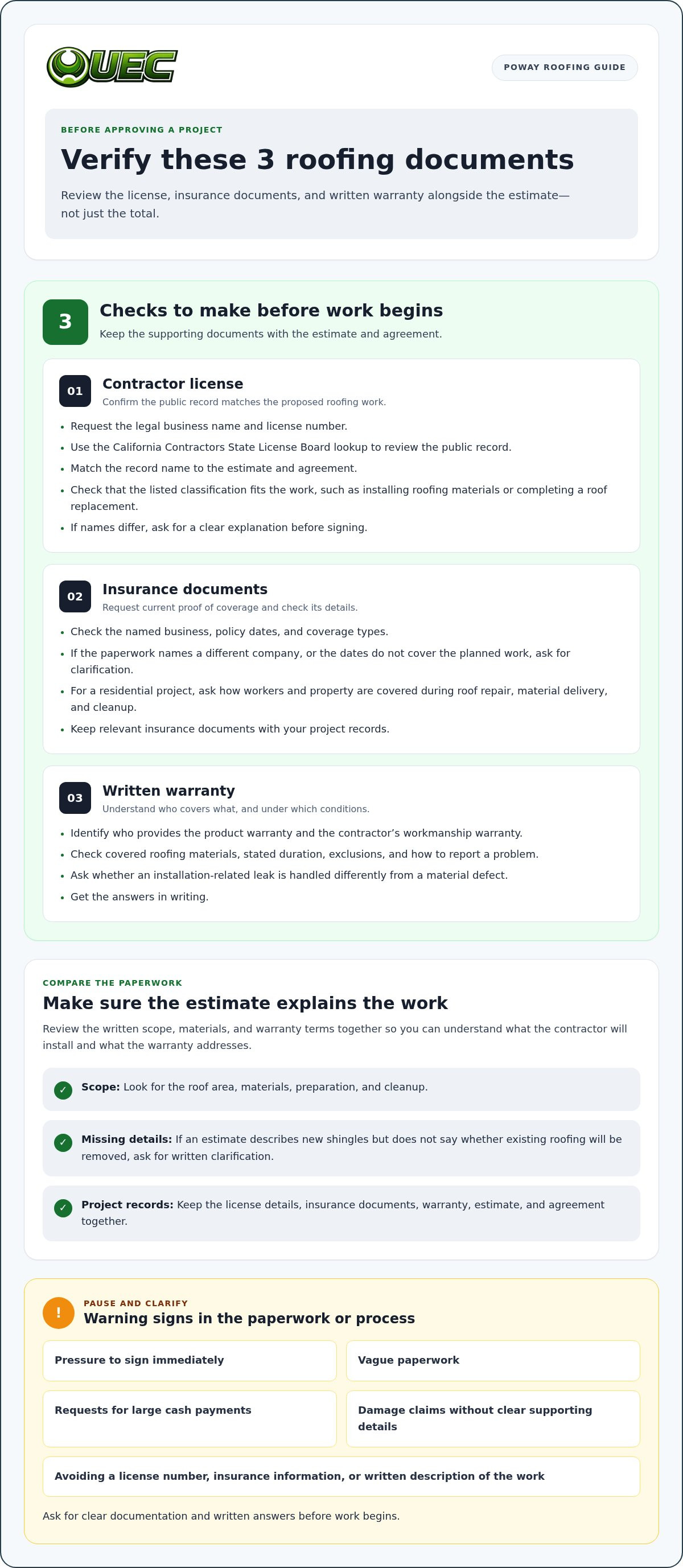
Before approving a Poway roofing project, review the contractor’s license details, insurance documents, and written warranty. Keep each document with the estimate so you can compare the proposed roof repair or replacement with the agreed work.
Warning signs include pressure to sign immediately, vague paperwork, requests for large cash payments, or claims of damage without clear supporting details. Pause if the contractor avoids providing a license number, insurance information, or a written description of the work.
Ask for the contractor’s legal business name and license number, then use the California Contractors State License Board lookup to review the public record. Match the name on the record to the estimate and agreement. Check that the listed classification fits the proposed roofing work, such as installing roofing materials or completing a roof replacement. If the names differ, ask for a clear explanation before signing.
Review insurance separately. Request current proof of coverage and check the named business, policy dates, and coverage types. If the paperwork names a different company, or the dates don’t cover the planned work, request clarification before work begins. For a residential project, ask how workers and property are covered during roof repair, material delivery, and cleanup. Keep the relevant documents with your project records.
Read warranty terms as carefully as the scope of work. A product warranty and a contractor’s workmanship warranty can cover different things, so identify who provides each one and what conditions apply. Check the covered roofing materials, stated duration, exclusions, and steps for reporting a problem. For example, ask whether a leak related to installation is handled differently from a material defect. Get the answers in writing.
Compare the paperwork with the estimate, not just the total. The scope should identify the roof area, materials, preparation, and cleanup. For example, if an estimate describes new shingles but says nothing about removing existing roofing, ask for written clarification. Specific terms make it easier to understand what the contractor will install and what the warranty addresses.
- Match the license record to the business named on the estimate.
- Review insurance names and dates before scheduling work.
- Keep written warranty terms with the final project documents.
Poway weather and roof exposure can influence material choices, but they don’t replace clear documentation. A written scope, current insurance details, and understandable warranty terms help you protect your home and assess whether the proposed roofing services fit your project.
Poway Roofer Reviews: Customer Praise and Complaints
For Poway homeowners, reviews are most useful when they describe the roof’s condition after the work, not just the day crews finished. Look for comments about whether a leak stayed resolved or whether replacement materials looked consistent with the existing roof. These observations offer a different perspective from general ratings or brief service descriptions.
A positive review might explain that repaired tiles blended well with the surrounding roof, or that the homeowner no longer noticed water entering an affected area. Treat such statements as personal experiences, not proof of performance on every home. Poway roofs differ in material, age, design, and exposure, so the review’s specific circumstances matter.
Complaints may focus on results that didn’t meet expectations. For example, a reviewer might describe a visible difference in replacement materials or say a leak returned after work. Read the account for what the homeowner observed and how the issue was described. A review alone can’t establish the technical cause, but it can show which outcome concerned that customer.
Consider how the review describes the problem’s progression. A comment about water appearing in a different area after a repair may raise a different question from one describing the original leak continuing. Likewise, a concern about the finished appearance differs from a complaint about roof performance. These distinctions help Poway homeowners understand what the reviewer is reporting.
- Notice whether praise refers to appearance, water protection, or the finished roof.
- Separate reported outcomes from the reviewer’s conclusions about their cause.
- Read complaints for the specific condition the homeowner says occurred.
Look for context that explains the reviewer’s expectations. A homeowner comparing a new tile with an older roof may focus on color or appearance, while someone describing a leak may care most about whether water intrusion stopped. Neither perspective applies automatically to another Poway property. The roof system and original concern shape how each outcome should be understood.
Reviews that describe results over time can add useful context, especially when homeowners explain what changed after the work. Still, don’t treat a single positive or negative account as a complete assessment. Use the review to identify the outcome that matters to you, then consider whether your roof has similar conditions and materials.
A balanced reading also means noticing what a review doesn’t establish. A homeowner’s account can describe what they saw, but may not reveal concealed roof conditions or the technical reason for a result. In Poway, use praise and complaints as real-world perspectives while keeping your roof’s condition and documented project details central to the decision.
Comparing Poway Roofer Reviews to Nearby Cities
Compare local roofer reviews in Poway with feedback from other San Diego County communities, such as Escondido, Santee, and San Diego. Focus on similar project types and roof systems, not city rankings. A Poway tile-roof review and an Escondido shingle-replacement review can describe different work, even when both discuss communication.
Group feedback by location and project type before comparing patterns. Separate residential projects from commercial ones, then note whether each review covers an inspection, repair, or replacement. This keeps unlike experiences from blending together. For example, a Poway homeowner’s account of tile work is more relevant to a similar project than a general comment about commercial roofing.
Nearby San Diego County reviews can help show whether experiences recur across communities. Compare the details reviewers provide, such as what work was completed and how questions were handled. Don’t assume a contractor’s service or project process is identical in Poway, Santee, and San Diego. The written scope for your home remains the clearest description of the work being considered.
Southern California geography extends beyond Poway. Reviews from Menifee, Temecula, Lake Elsinore, Canyon Lake, Corona, Anaheim, Moreno Valley, Winchester, Wildomar, Murrieta, Riverside, Orange, Huntington Beach, Fallbrook, Vista, Escondido, Carlsbad, San Diego, and El Cajon offer broader regional context. Treat them as regional examples rather than direct local comparisons. Roof type and project scope matter more than a city label.
- Match the review’s location and project type to your own.
- Separate residential feedback from commercial project accounts.
- Use broader regional reviews as context, not direct substitutes.
Review dates and descriptions also affect how useful feedback is. A detailed Poway account of a completed repair may help you understand that homeowner’s experience, while an older review about a different project offers less direct comparison. Read the full account for context. A date by itself doesn’t establish workmanship or service quality.
Use regional differences to form practical questions. If a review from Riverside County describes a different roof system, ask how the proposed work relates to your Poway home’s roof. If a review from Orange County discusses a specific material, compare its description with the materials in your estimate. This keeps the comparison grounded in project details rather than assumptions about location.
Compare patterns without treating review volume as a measure of quality. Feedback from across Southern California may cover varied projects, while Poway reviews may describe work more relevant to your home. Read for useful details, then assess whether they apply to your roof. Nearby and regional reviews provide context, not a substitute for evaluating the specific proposal.
What should I ask and compare when getting roofing estimates in Poway?
Compare Poway roofing estimates by scope, materials, preparation, and written terms, not just the bottom line. Ask each contractor to describe the same work. For example, a quote for replacing shingles should identify the roof areas involved and explain how existing materials will be handled.
Start with the inspection findings. Ask what the contractor observed, where the concern appears, and whether the estimate addresses the cause or only visible damage. If one estimate recommends repair and another recommends replacement, ask each contractor to explain the reasoning and included work. Request written details you can compare side by side.
Review the proposed materials carefully. An estimate should identify the roofing materials and relevant components rather than relying on a broad phrase such as “new roof.” Ask how the recommended option suits your roof type and conditions at your Poway home. If proposals name different materials, compare their descriptions before comparing totals.
- Check that each estimate covers the same roof areas and tasks.
- Compare named materials and the preparation each proposal includes.
- Look for cleanup, project terms, and written warranty information.
Ask how the contractor plans to protect landscaping, walkways, and other property during the work. Clarify who handles debris and cleanup, and whether the estimate includes those steps. For example, a proposal that lists removal but says nothing about disposal leaves a practical gap. Get the scope clarified in writing before accepting it.
Use your review notes to frame useful questions. If homeowners describe unclear updates, ask how project changes will be documented and communicated. If a review mentions a leak returning after repair, ask what findings support the proposed solution. Specific questions make it easier to compare the contractor’s explanations with the work stated in each estimate.
Compare terms as well as technical descriptions. Check the payment schedule, cancellation language, start conditions, and warranty documents included with each proposal. Make sure the business name on the estimate matches the contractor’s paperwork. Keep copies of the estimate, written clarifications, and inspection details together for a clear record.
Before deciding, mark differences between the proposals. One may include more preparation, a different material, or added work around roof details. Ask for an explanation of each difference rather than assuming the shortest estimate is equivalent. A complete comparison depends on matching the scope and understanding what each written term covers.
For a project-specific discussion, share your roofing project details and use the scope questions above to guide the conversation.
Christensen Roofing says Poway roofing is required by code to be Class A fire-rated, so ask each contractor to identify the proposed fire rating in writing and confirm that the estimate specifies it. Christensen Roofing says a full roof replacement in Poway can cost tens of thousands of dollars. That makes it especially useful to compare the complete scope, materials, and terms before choosing; if a key detail is missing or unclear, request a written explanation and revised estimate before agreeing to the work.
UEC Roofing: leak repair
UEC Roofing provides leak repair for homeowners dealing with roof leaks or signs of water intrusion. Its brick-and-mortar presence in Lake Elsinore and record of over 2,000 successful projects in the region reflect an established local presence. Turn to its roof repair services when you need to address a problem, or consider a roof tune up for ongoing maintenance.
Before reaching out, note where water appears and when you notice it. Share those details and any questions about the work. This helps focus the discussion on your roof concern and the appropriate next step.
Contact UEC Roofing to discuss your roof.
Make your next roofing decision with confidence
Use local roofer reviews in Poway as a starting point, then let your home’s needs shape the next step. A visible leak calls for focused attention; a roof that needs upkeep may benefit from a roof tune-up. Matching the concern to the right work keeps the conversation practical and focused on protecting your property.
UEC Roofing provides leak repair, roof tune-ups, and broader roofing services for homeowners addressing roof concerns. Share what you’ve noticed and the questions you still have. Schedule Today to discuss a practical next step for your roof.
Contact UEC Roofing to discuss your roof and move forward with a thoughtful plan for your home.
Frequently Asked Questions
What are the top-rated roofers in Poway, CA, according to recent customer reviews?
There’s no dependable single ranking that captures every Poway homeowner’s needs. Review scores can change, and a roofer praised for one type of project may not suit another. Compare feedback with your specific issue, such as a leak or damaged tile. UEC Roofing provides leak repair and roof tune-ups, so consider whether those services match the work your home needs.
Which local roofers offer free inspections, written estimates, or workmanship warranties?
Offers vary by roofer, so review each company’s written terms rather than relying on comments. A free inspection, a written estimate, and a workmanship warranty are separate items. Before scheduling or signing, look for inspection conditions, a detailed scope of work, and the warranty provider and terms. Keep those documents together so you can compare exactly what each roofer has put in writing.
Are Poway roofers licensed and insured in California, and how can I check their CSLB license?
Check each roofer individually; reviews don’t establish license status or insurance coverage. Search the California Contractors State License Board (CSLB) license lookup using the business name or license number. Match the record’s business identity and classification to the estimate and agreement. Separately request current proof of insurance, then compare its named business with the contracting entity. Keep both records with your project documents.