
HOA Roofing Requirements in Lake Elsinore: The 2026 Homeowner Guide
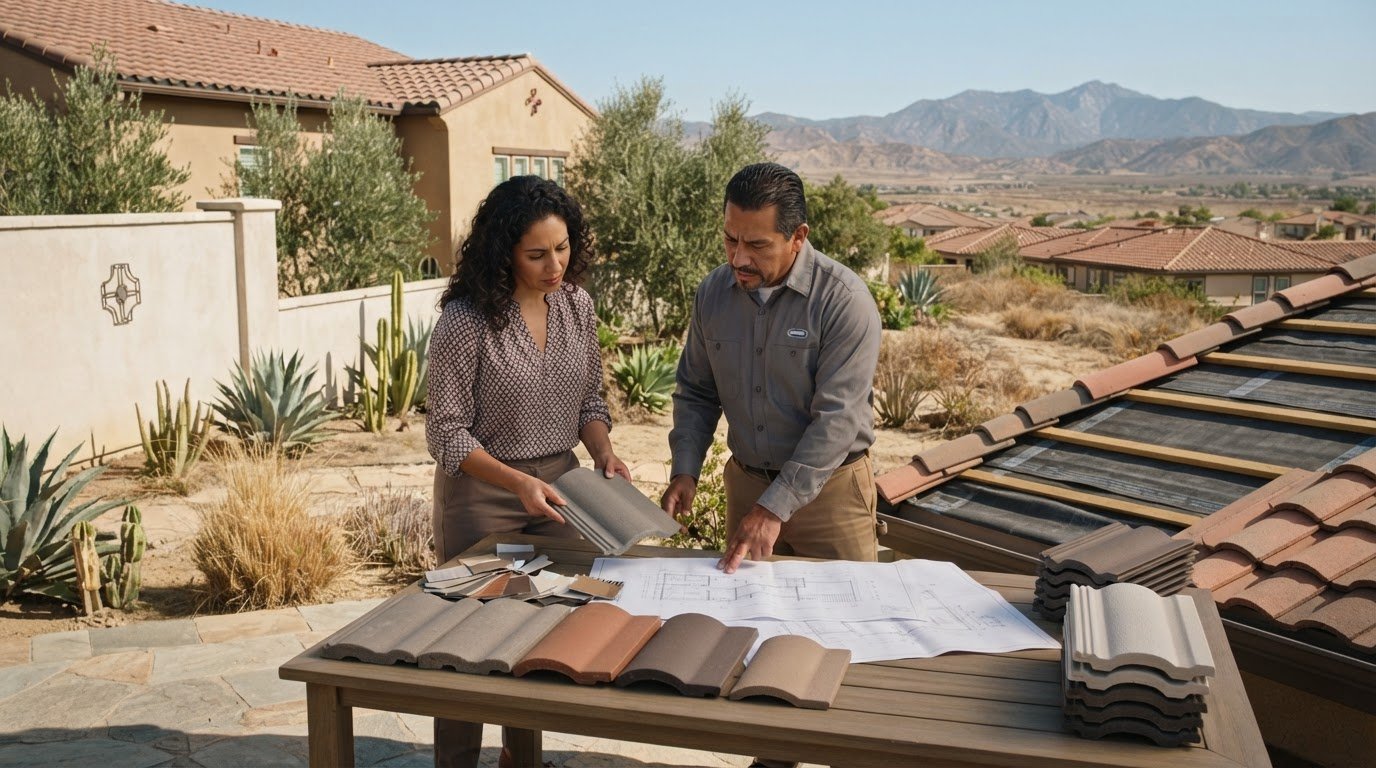
Condo Control reports that roughly 65% of California homeowners live in a common-interest community, yet few anticipate the friction between neighborhood aesthetic rules and state building codes. When your home needs attention, understanding the HOA roofing requirements Lake Elsinore associations enforce shouldn't feel like an uphill battle against paperwork and red tape.
Waiting weeks for Architectural Review Committee approval is stressful, especially when you're trying to balance neighborhood CC&R color palettes with California's Title 24 energy standards and wildfire mandates. You want a durable, fire-safe roof that protects your investment without triggering formal violation letters. This guide will show you how to navigate Lake Elsinore HOA architectural guidelines, approved materials, and municipal permitting with complete confidence. We examine ARC submission steps, Class A fire-rating rules, cool roof standards, and practical solutions like tile lift-and-relay to get your project approved on the first pass.
Key Takeaways
- Mastering the HOA roofing requirements Lake Elsinore associations enforce ensures your Architectural Review Committee application is approved without costly back-and-forth delays.
- Balancing CC&R aesthetic rules with California Title 24 energy mandates and Class A fire safety standards requires careful material selection.
- Assembling complete documentation, including manufacturer spec sheets, physical samples, and municipal permits, protects your project from immediate rejection.
- Tile lift and relay services offer an ideal solution for worn underlayment, restoring roof integrity while preserving your association-approved exterior appearance.
- Partnering with an established Lake Elsinore roofing contractor streamlines municipal permitting and association paperwork from start to finish.
Understanding HOA Roofing Rules in Lake Elsinore: CC&Rs and Architectural Guidelines
Every planned community operates under legally binding Covenants, Conditions, and Restrictions (CC&Rs). These recorded documents govern property modifications, establishing mandatory standards to preserve visual harmony and protect neighborhood property values across Riverside County. If you need a refresher on these governing bodies, exploring what is a Homeowner Association (HOA)? helps explain how these private corporations operate. In Lake Elsinore, your board delegates exterior enforcement to an Architectural Review Committee (ARC). This committee evaluates proposed roofing materials, tile profiles, and color swatches against published design standards before any work begins.
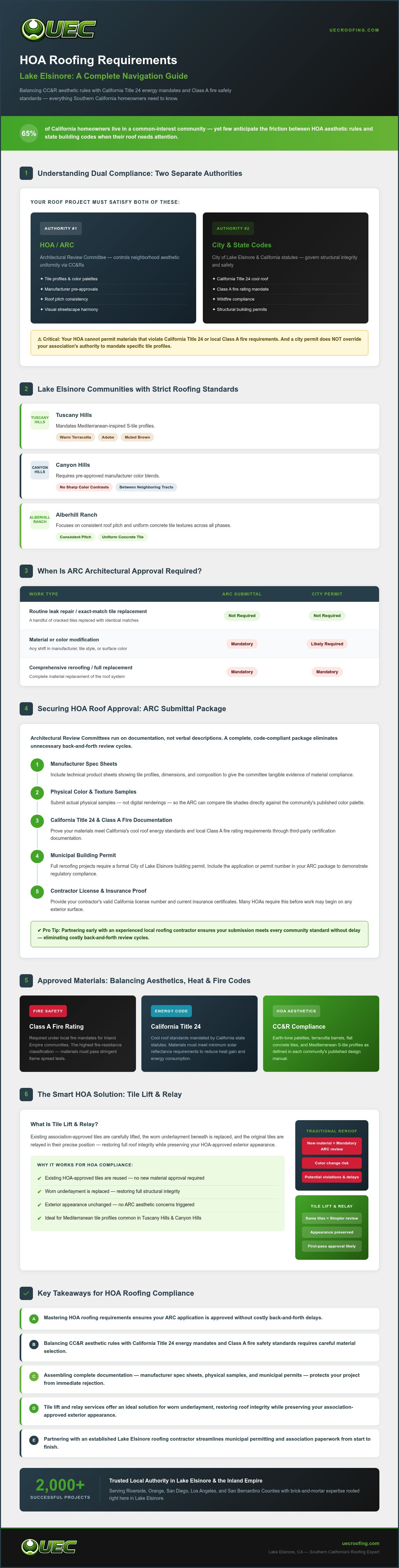
A critical point often trips up property owners: private CC&Rs and municipal building codes exist on separate tracks. While your HOA controls neighborhood aesthetic uniformity, the City of Lake Elsinore and California state statutes govern structural integrity and safety. Your HOA cannot legally permit materials that violate California Title 24 cool roof codes or local Class A fire requirements. Conversely, pulling a city permit does not override your association's authority to mandate specific clay tile or concrete profiles. Satisfying HOA roofing requirements Lake Elsinore associations enforce means achieving dual compliance with both authorities.
Common Lake Elsinore Communities with Strict Roofing Standards
Master-planned neighborhoods throughout Lake Elsinore enforce precise architectural guidelines to maintain cohesive streetscapes. Developments like Tuscany Hills, Canyon Hills, and Alberhill Ranch feature strict design manuals that emphasize earth-tone palettes, terracotta barrels, and flat concrete tiles.
- Tuscany Hills: Mandates Mediterranean-inspired S-tile profiles in warm terracotta, adobe, or muted brown shades.
- Canyon Hills: Requires pre-approved manufacturer color blends, prohibiting sharp color contrasts between neighboring tracts.
- Alberhill Ranch: Focuses heavily on consistent roof pitch and uniform concrete tile textures across all phases.
In gated subdivisions and shared-boundary communities, maintenance boundaries create distinct responsibilities. Homeowners must verify whether their CC&Rs designate the roof as an individual owner responsibility or a common area asset managed by the association.
HOA Jurisdiction: When Is Architectural Approval Legally Required?
Not every roof service triggers an extensive board review. Under standard California Davis-Stirling Act guidelines, associations allow emergency repairs when active leaks threaten immediate interior structural damage. However, you must know where routine maintenance ends and formal ARC oversight begins.
- Routine leak repair and maintenance: Replacing a handful of cracked tiles with exact-match replacements typically does not require ARC submittals.
- Material or color modifications: Any shift in product manufacturer, tile style, or surface color requires mandatory committee pre-approval.
- Comprehensive reroofing: Full replacements trigger mandatory ARC applications and formal city building permits.
Addressing HOA roofing requirements Lake Elsinore boards establish protects you from costly rework down the road. Coordinating with your roofer early ensures all proposed components match CC&R rules perfectly.
How to Secure Lake Elsinore HOA Roof Approval: Step-by-Step ARC Process
Securing architectural approval does not have to be a slow, frustrating ordeal. Architectural Review Committees run on documentation, not verbal descriptions. Providing a complete, code-compliant package up front eliminates unnecessary back-and-forth review cycles. When you submit clear proof that your proposed materials satisfy published neighborhood aesthetics and current building codes, committees can issue swift determinations. Partnering early with an experienced local roofing contractor helps streamline the paperwork, ensuring your submission meets every community standard without delay.
Gathering Your Architectural Submittal Package
A successful ARC packet leaves no room for ambiguity. Volunteer board members need tangible evidence that your installation protects neighborhood aesthetics while aligning with California Residential Code roofing requirements for Class A fire resistance.
- Technical spec sheets: Manufacturer cut sheets showing exact product lines, fire testing ratings, and Title 24 compliance data.
- Physical samples: Actual tile samples or manufacturer color chips to verify true finish under direct sunlight.
- Contractor credentials: Valid CSLB license verification, along with current general liability and workers' compensation certificates naming the association if required.
- Project schematics: Clear roof plan drawings showing valleys, ridge caps, flashing details, and low-profile attic ventilation units.
Managing HOA Review Timelines and Notice Requirements
Under California Civil Code §4765, associations must maintain a fair, reasonable, and expeditious review process. Most CC&Rs in Lake Elsinore establish a 30-to-60-day review period. Because committees typically convene once a month, missing an agenda cutoff can postpone your project by several weeks. Check with your community property manager for submission deadlines. Always wait for formal written approval before staging material pallets on driveways, as unauthorized deliveries frequently trigger immediate warning notices.
Coordinating with City of Lake Elsinore Building Permits
Association consent represents only half of your compliance journey. The City of Lake Elsinore requires building permits whenever a reroof or repair exceeds 25% of the total roof area within a 12-month period. Architectural boards cannot waive this municipal mandate. Your roofer must pull the permit directly through the Lake Elsinore Building and Safety division. This ensures licensed accountability, triggers required progress inspections, and preserves manufacturer warranties while satisfying all HOA roofing requirements Lake Elsinore communities enforce.
Approved HOA Roofing Materials in Lake Elsinore: Balancing Aesthetics, Heat, and Fire Codes
Selecting roofing materials in Southern California requires satisfying multiple layers of oversight. While associations prioritize street-level aesthetics, inland regional conditions demand high thermal efficiency and strict fire defenses. Understanding your HOA's long-term maintenance cycles often mirrors the state's HOA Reserve Study Guidelines, which outline how communities budget for structural preservation. Knowing how different assemblies perform under local heat and fire regulations helps you choose an option that committee members approve without objection.
- Concrete and clay tile: Standard throughout master-planned communities; offers natural Class A fire protection and exceptional resistance against Inland Empire heatwaves.
- Composite architectural shingles: Permitted in select neighborhoods; must meet cool-roof reflectivity standards and high wind ratings.
- Standing seam metal: Highly durable and fireproof; occasionally restricted by architectural rules due to visible glare or industrial styling.
Concrete and Clay Tile Systems in Master-Planned Communities
Concrete barrel, 'S' profile, and flat tiles dominate Lake Elsinore because they withstand intense ultraviolet exposure and thermal shock. While tiles last for decades, the underlying waterproofing felt beneath them eventually deteriorates. A lift and relay roofing service solves this problem seamlessly. Crews carefully remove and salvage existing tiles, install premium underlayment, and reinstall the original tile. This approach satisfies strict HOA roofing requirements Lake Elsinore boards enforce because the external color, profile, and community aesthetic remain completely unchanged.
California Title 24 Compliance and Energy Star Shingles
Replacing more than 50% of an existing roof triggers California Title 24 cool-roof requirements across Southwest Riverside County. Steep-slope applications require roofing materials with a minimum Solar Reflectance Index (SRI) of 29. Modern roofing systems integrate specialized reflective granules that bounce solar radiation away from your home. This technology allows darker, earth-toned shingles and concrete tiles to satisfy state energy mandates without clashing with neighborhood architectural palettes. Pairing these reflective materials with balanced attic ridge vents lowers indoor cooling loads and extends shingle life.
Wildfire Defense and Cal Fire Class A Fire Ratings
Lake Elsinore foothill neighborhoods sit within mapped Very High Fire Hazard Severity Zones, where building codes mandate Class A fire-rated roof assemblies. Wind-driven embers represent the greatest risk to homes during Santa Ana wind events. Meeting regional safety mandates without violating HOA roofing requirements Lake Elsinore architectural committees establish requires several integrated components:
- Ember-resistant ridge vents: Specialized interior baffles block windblown embers from entering attic voids while permitting hot air exhaust.
- Class A non-combustible underlayment: Multi-ply synthetic membranes provide secondary defense beneath primary tiles or shingles.
- Perimeter bird stops: Metal or preformed eave closures block embers and nesting animals from penetrating open barrel tile voids.
Avoiding Costly HOA Roofing Violations, Penalties, and Project Delays
Overlooking CC&R architectural guidelines triggers swift administrative backlash from board members and property managers. The most frequent violations involve mismatched ridge cap angles, non-approved color tints, and unpainted flashings that clash with adjacent homes. While California Civil Code § 5850(c) generally caps individual standard fines at $100 per violation, ongoing non-compliance adds up quickly as penalties compound. Beyond routine monetary assessments, unapproved work clouds real estate title disclosures. Unresolved architectural disputes stall property transfers during escrow until the modifications receive formal board sign-off or complete remediation.
The Danger of Starting Roofing Work Without Formal Approval
Jumping ahead of committee decisions creates severe legal and financial exposure. An immediate stop-work order from the board halts progress instantly, leaving open roof decks vulnerable to unexpected Southern California rainstorms. When outside crews violate community parking limits, block access gates, or operate during restricted quiet hours, the association holds the homeowner directly liable. Most critically, an unapproved color or profile can lead to mandatory tear-off demands. Replacing a non-compliant roof a second time wastes weeks of effort and strains relations with neighbors.
How to Resolve Architectural Committee Objections
Facing a conditional approval or flat rejection does not mean starting from scratch. Architectural committees evaluate revisions systematically when you provide clear, objective evidence.
- Demand written clarification: Request the exact CC&R section or design guideline cited in the denial to pinpoint the issue.
- Provide neighboring precedent: Present photographs of adjacent, previously approved properties featuring identical materials or color profiles.
- Offer physical finish boards: Supply high-definition material swatches and concrete tile cuts to demonstrate exact curb appeal compatibility.
Working with an experienced residential roofing contractor in Southern California ensures your ARC submittal packet aligns with local expectations from day one. If your association requests revisions, your contractor can supply alternative spec sheets that keep the project moving forward without compromising quality.
Protect your home from costly compliance disputes. Schedule your assessment with a licensed professional by visiting UEC Roofing today.
Partnering with a Local Lake Elsinore Contractor for Guaranteed HOA Compliance
Hiring a contractor who operates outside your region often leads to avoidable friction with local management companies. A roofing professional must understand community-specific nuances, from neighborhood paint codes to municipal inspection habits. As a brick-and-mortar roofing contractor based directly in Lake Elsinore, UEC Roofing has completed over 2,000 successful projects across Southern California. That volume translates into hands-on familiarity with the design guidelines enforced throughout Riverside County, Orange County, San Diego County, Los Angeles County, and San Bernardino County.
Managing an architectural submission takes time and patience. Our team handles the administrative heavy lifting by assembling physical sample boards, pulling official engineering spec sheets, and processing municipal paperwork through the City of Lake Elsinore Building and Safety division. This thorough preparation ensures full alignment with published CC&Rs while protecting your home with long-term workmanship standards.
Why Hyper-Local Experience Matters for HOA Approvals
Direct community involvement simplifies project approvals. Contractors rooted in the local area offer distinct advantages when navigating neighborhood committees:
- Familiarity with regional managers: Direct communication with community associations across Lake Elsinore, Canyon Lake, and Menifee speeds up packet reviews.
- Cataloged neighborhood palettes: Immediate knowledge of pre-approved tile profiles prevents guesswork during product selection.
- City inspector rapport: Professional working relationships with local municipal inspectors ensure timely sign-offs at every stage.
Comprehensive Services Tailored to HOA Standards
Every planned community presents different maintenance challenges. Whether your property needs preventative care or an entirely new roof, our services align with local aesthetic and energy rules.
Preventative care extends the lifespan of older tile systems without triggering complex architectural reviews. Scheduling a targeted roof tune up addresses slipped tiles, deteriorated pipe collars, and blocked valley flashings before leaks develop. When the waterproofing beneath your tiles reaches the end of its functional life, precision felt replacement and tile lift-and-relay methods solve chronic water intrusion while keeping your original, approved tiles in place.
For complete replacements, we install high-performance tile, composite shingle, metal, foam, and flat roofing assemblies engineered to satisfy Title 24 cool-roof metrics and regional wildfire safety mandates. You never have to compromise on safety or curb appeal. Contact our local team today to schedule a thorough HOA roof inspection and secure your home with a proven roofer for life.
Protect Your Property Value with Confident HOA Compliance
Satisfying the HOA roofing requirements Lake Elsinore communities enforce comes down to precision and preparation. Aligning your neighborhood CC&Rs with California Title 24 cool-roof standards and Class A fire ratings protects both your home and your budget. Whether you choose a tile lift and relay to preserve original aesthetics or invest in a full replacement system, thorough submittals prevent unnecessary delays and code violations.
You don't have to navigate architectural review boards and municipal building inspectors alone. As a brick-and-mortar roofing contractor based in Lake Elsinore with over 2,000 completed roofing projects across Southern California, we provide dedicated assistance with HOA architectural submittal packages and city permitting. Protect your investment, safeguard your family, and work with a dependable roofer for life. Contact our local team to schedule your comprehensive HOA roof inspection with UEC Roofing today.
Frequently Asked Questions
Can my Lake Elsinore HOA legally dictate what color or material I choose for my roof?
Yes, your HOA holds legal authority under California's Davis-Stirling Act and community CC&Rs to restrict exterior aesthetics. They can specify approved profiles, materials, and color palettes to preserve architectural harmony. However, their rules cannot violate state building mandates, such as California Title 24 energy standards or mandatory Class A wildfire safety codes. If an association rule conflicts with state safety laws, the state building code takes precedence.
Do I need HOA architectural approval for minor roof leak repairs?
Generally, no. Emergency leak repairs and minor maintenance that replace a few damaged tiles or fix localized flashing don't require formal architectural submittals. Davis-Stirling protections allow urgent action to prevent interior water damage. As long as your contractor uses matching materials without altering the roof's exterior appearance, you avoid ARC reviews. If repairs alter visible roof sections or cover large surface areas, submit plans for approval first.
How long does the Architectural Review Committee process typically take in Lake Elsinore?
The review timeline usually takes between 30 and 45 days, depending on your community bylaws. Committees typically meet once per month to review complete submittal packets. If your application lacks material specification sheets, physical color samples, or proof of contractor licensing, the committee can reject or postpone the request. Submitting a thorough package on your initial try prevents rolling your review into the next month's agenda.
What happens if a contractor installs an unapproved roof on my HOA property?
Installing an unapproved roof triggers formal violation notices, hearing summons, and recurring monetary fines from the board. Beyond financial penalties, the association can issue a cease-and-desist demand or pursue legal action requiring complete removal and replacement of unauthorized materials at your expense. Non-compliant work also creates title clouds, blocking home refinancing or sales during escrow until the property formally satisfies all HOA roofing requirements Lake Elsinore associations maintain.
Are tile lift and relay projects subject to strict HOA architectural review?
Tile lift and relay projects rarely face lengthy committee scrutiny because the visible exterior remains identical. Crews remove existing tiles, replace worn underlayment felt, and reinstall the original tile in its exact configuration. Since your roof's profile, color, and texture do not change, most architectural committees classify this work as routine maintenance or grant expedited approval. It provides an efficient way to resolve leaks without violating neighborhood CC&Rs.
How do California Title 24 cool roof requirements interact with HOA color restrictions?
State energy mandates and HOA aesthetics align easily with modern roofing products. Title 24 requires steep-slope reroofs to meet specific Solar Reflectance Index levels. Manufacturers now formulate dark, earth-toned shingles and concrete tiles with specialized reflective granules that meet state reflectivity thresholds without looking pale or bright. Submitting manufacturer spec sheets proving this dual compliance satisfies both California energy efficiency laws and neighborhood HOA roofing requirements Lake Elsinore boards establish.
Does the City of Lake Elsinore require a permit if my HOA already approved my roof?
Yes. HOA architectural sign-off does not replace municipal building permits. The City of Lake Elsinore Building and Safety division requires an official building permit for any reroof or major repair covering more than 25% of the total roof surface within a single year. Your roofing contractor must pull this permit directly, ensuring necessary progress inspections are completed and that the final installation complies with municipal safety and structural codes.