
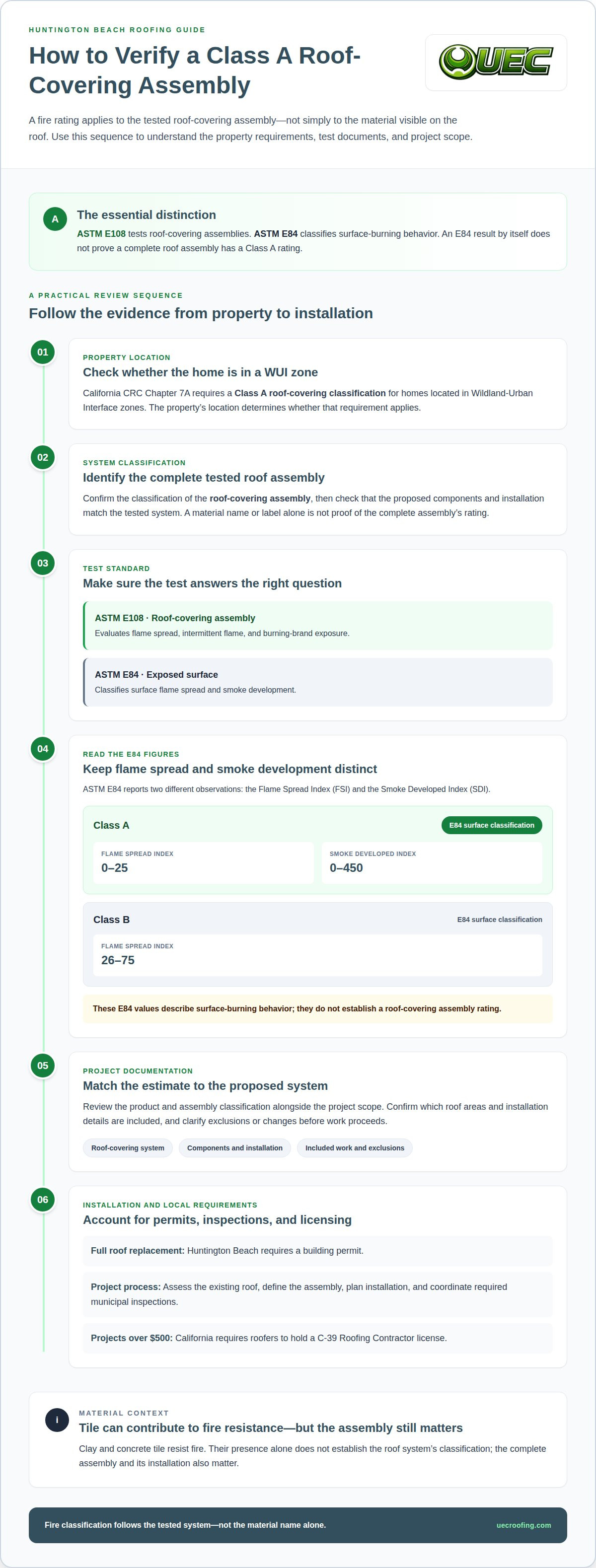
A roof’s fire rating belongs to the tested roof-covering assembly, not just its visible material. For Class A fire rated roofing in Huntington Beach, that distinction matters: ASTM E108 evaluates roof coverings for flame spread, intermittent flame, and burning-brand exposure, while ASTM E84 classifies surface burning. Under ASTM E84, Class A corresponds to a Flame Spread Index of 0-25 and a Smoke Developed Index of 0-450.
It’s reasonable to look for fire-resistant materials when planning a roof, but the material alone doesn’t establish the assembly’s rating. Clay and concrete tile resist fire, while the complete roof system and its installation also matter. This guide explains what the ratings mean, how the testing standards differ, and why a surface-burning classification isn’t the same as a roof-covering rating. You’ll also learn how tile contributes to fire resistance and what to consider when evaluating Class A fire rated roofing in Huntington Beach.
Key Takeaways
- Learn why a roof’s fire performance depends on the complete assembly, not just the surface material.
- Understand what ASTM E84 measures and how its surface-burning classifications differ from roof-covering fire ratings.
- See how clay and concrete tile contribute to fire resistance, and what the full roofing system still needs to do.
- Compare roofing material categories and the factors that matter when choosing a fire-rated system for a Huntington Beach home.
- Find out when roof repair, leak repair, or a roof tune-up can help address concerns with an existing roof.
Roofing services in Huntington Beach and nearby communities
Roofing decisions in Huntington Beach involve permits, fire exposure, and the design of the complete roofing system. A clear project scope connects local requirements with the roof’s materials and installation.
Huntington Beach requires a building permit for full roof replacements. California CRC Chapter 7A requires a Class A roof-covering classification in Wildland-Urban Interface zones; that rule applies to homes located within those zones.
A roof replacement typically starts with assessing the existing roof and defining the proposed assembly. The roofer then plans the installation, addresses the roof’s layers and details, and coordinates required municipal inspections. Permit approval and inspections are part of the project process, not a substitute for selecting a properly tested system.
Wildfire and Fire-Zone Roofing Requirements
Fire-zone requirements depend on whether a property falls within a Wildland-Urban Interface zone. California CRC Chapter 7A requires Class A roof-covering classification in those zones, so location affects the applicable fire requirement. The relevant decision is the property’s fire-zone status and the classification of the roof covering assembly, rather than the appearance of a single roofing material.
Licensed Class A Roofing Installers
For roofing projects over $500, California requires roofers to hold a C-39 Roofing Contractor license. A Class A installation also depends on fitting the tested roofing assembly together as designed, rather than relying on a material label alone. The scope should identify the roof-covering system and the work involved, so the licensing category and proposed installation align with the project.
For Huntington Beach homes, the choice of roofing systems should account for the property’s location and fire-rating needs. A nearby community may have different fire-zone conditions, so requirements should be tied to the actual address rather than assumed across Orange County. For example, a home inside a designated WUI zone falls under the Chapter 7A Class A requirement, while the location itself determines whether that rule applies.
Before work begins, the project scope should define the replacement area, proposed roof-covering assembly, permit process, and inspection coordination. These details help homeowners understand how the installation relates to local requirements. For Class A fire rated roofing in Huntington Beach, confirm the assembly’s classification and how it fits the property’s applicable fire-zone requirements.
Review the proposed roof-covering assembly, its fire classification, and how the installation will be documented in the project scope. Ask the roofer to explain how the selected system fits the property and what work is included, then review those details alongside the planned permit and inspection steps. A clear estimate makes it easier to compare proposed work without treating the material name alone as proof of a complete system.
Read the estimate in context: confirm which roof areas and installation details it covers, and clarify any exclusions or changes before work proceeds. This keeps cost discussions tied to the specified assembly and the project’s defined scope.
ASTM E84 surface-burning classifications
ASTM E84 classifies how a material’s exposed surface responds to flame spread and smoke development. Class A has a Flame Spread Index (FSI) of 0-25 and a Smoke Developed Index (SDI) of 0-450. Class B has an FSI of 26-75. These values describe surface-burning behavior, not a roof’s complete fire rating.
ASTM International explains the test setup in section 4.2: “This test method exposes a nominal 24-ft (7.32 m) long by 20-in. (508 mm) wide specimen to a controlled air flow and flaming fire exposure adjusted to spread the flame along the entire length of the select grade red oak specimen in 5 1/2 min.” The test compares how flame travels across a prepared specimen under controlled conditions.
FSI and SDI describe different observations. FSI measures flame spread relative to the test scale; SDI records smoke development. A Class A result therefore has two reported values, and the indices should be read together. Red oak flooring has an FSI of 100 in ASTM E84 scale references, while cement board has an FSI of 0. Those examples help illustrate the scale, but they do not establish a roof assembly rating.
For a Huntington Beach roofing project, the important distinction is the test’s scope. ASTM E84 evaluates surface burning. A roof-covering assembly is tested under ASTM E108 for flame spread, intermittent flame, and burning-brand exposure. A Class A E84 classification by itself does not prove that shingles, underlayment, and other roof components form a Class A roof-covering assembly.
A professional roofer verifies the product’s stated classification and the tested assembly details, then matches the proposed components and installation to that assembly. The documentation should identify the relevant product and system, rather than relying on a generic material description or isolated E84 result.
For commercial buildings and homes, compare the test standard and classification with the intended application. Key distinctions include:
- ASTM E84: surface flame spread and smoke development, reported as FSI and SDI.
- ASTM E108: roof-covering assembly exposure, including burning-brand testing.
- Class A E84: FSI of 0-25 and SDI of 0-450.
- Class B E84: FSI of 26-75.
These labels answer different questions. For example, a surface material’s E84 result cannot stand in for the classification of the complete roof-covering assembly. In Huntington Beach, understanding that distinction helps homeowners assess fire-rating documents accurately and keep the material’s test result separate from the roof system’s performance classification.
Class A fire-rated roofing
Class A provides the highest fire resistance among the listed roofing classifications. For residential roofs, the rating applies to the tested assembly, so the material selection and installation need to match it.
Roofing Material Cost and Durability
Class A asphalt shingles, tile, and metal differ in upfront cost and service life. Exact project cost depends on the material, roof design, existing conditions, and installation scope. In Huntington Beach’s coastal environment, asphalt shingles may last around 15 to 20 years, but actual service life varies with the product, installation, maintenance, and exposure. Metal roofs are sometimes estimated to last 40 to 70 years; actual longevity depends on the roofing system and conditions. Tile manufacturers offer limited lifetime warranties, but a warranty does not establish the roof’s actual lifespan.
Compare the full system, not only the visible covering. Asphalt shingles are available with Class A, B, or C fire ratings, and Class A provides the greatest fire resistance. A tile or metal roof’s rating also depends on its tested assembly. For a residential project, weigh durability, the required fire classification, roof condition, and the documented system together.
Local Class A Roofing Requirements
Huntington Beach’s Class A requirement depends on the home’s location. California CRC Chapter 7A requires Class A roof-covering classification in Wildland-Urban Interface zones. This does not establish a blanket requirement for every Huntington Beach property. The applicable fire-zone status is the key distinction when determining which classification applies.
Insurance discounts may be available for homes with impact-resistant or fire-resistant roofing materials, including metal roofing. Eligibility and any potential discount depend on the insurer’s policy.
Installation can undermine a rating if the completed roof differs from the tested assembly. Substituting components, changing the specified underlayment, or altering installation details can mean the system no longer matches the tested configuration. A professional identifies the assembly and follows its component and installation requirements. Maintenance matters too: damage or repairs involving different materials can change the system. Repairs should be assessed against the original assembly rather than treating components as interchangeable.
Class A fire-rated roofing in Huntington Beach should be evaluated as a complete system. A product label alone cannot show whether the installed roof matches the rated assembly. Compare the documented fire classification, material durability, roof condition, and applicable property requirements. This supports a sound long-term decision without treating warranty language as a promise of service life.
Fire resistance of clay and concrete tile
Clay and concrete tiles resist fire because the tile material itself does not readily burn. That makes tile worth considering for homeowners prioritizing fire resistance in Huntington Beach. Still, a tile surface alone does not establish the roof’s fire rating. The rating applies to the complete tested roof-covering assembly, including its specified components and installation.
For a tile roof to qualify as Class A, the assembly must meet the applicable roof-covering fire test. ASTM E108 evaluates roof coverings for flame spread, intermittent flame, and burning-brand exposure. Tile material cannot substitute for the assembly’s classification. The roof design and the combination of components must match the tested system.
Underlayment is a key part of the roof system beneath the tiles. Tile-roof underlayment needs replacement over time, even when the tiles themselves may last a lifetime. Intact visible tiles do not necessarily mean the underlying layers remain in good condition. A professional assessment should consider both the tile field and the concealed components.
During installation or repair, the roofer should identify the existing tile type and assembly details before changing components. Replacing a tile without considering the system beneath it addresses visible damage but may not resolve deterioration below the surface. A roof review can distinguish isolated tile damage from underlayment concerns and help determine whether repair or broader work is appropriate.
- Tile condition: assess visible cracks, displacement, and areas affected by past repairs.
- Underlayment: consider its age and condition, even when the tile surface appears sound.
- Assembly rating: match the roof’s components and installation to the tested fire-rated system.
- Repair scope: address the cause and location of damage, not only the visible symptom.
Tile manufacturers offer limited lifetime warranties, but warranty language and fire classification answer different questions. A warranty describes product coverage under its terms; it does not establish that every tile roof is Class A rated. For a Huntington Beach home, distinguish the tile’s fire-resistant properties from the tested rating of the complete assembly.
When evaluating clay or concrete tile, have the entire roof system assessed. The review should connect tile condition, underlayment needs, repair scope, and assembly documentation. This helps preserve the roof’s intended performance and avoids assumptions based only on the visible surface.
Which roofing materials are Class A fire rated and suitable for homes in Huntington Beach?
Roofing material options for Huntington Beach homes have different ratings depending on the product and assembly. A useful comparison considers fire classification, coastal exposure, roof design, and how the complete system will be installed.
Asphalt shingles are sold with Class A, B, or C fire ratings, and Class A provides the greatest fire resistance. That range means “asphalt shingles” alone doesn’t identify a roof’s rating. The specific product and its tested roof-covering assembly matter. For a residential roof, the proposed installation should match the applicable assembly details.
Clay and concrete tile are noncombustible materials that resist fire, making them common considerations for fire-conscious homeowners. Their material properties still don’t establish the rating of the complete roof system. Tile, underlayment, and other specified components must be considered together. In Huntington Beach, a professional assessment should also account for the existing roof and whether its underlayment needs attention.
Metal roofing is another category to consider. The full roof-covering assembly determines its fire classification, not the metal surface alone. For homes within a mile of the ocean, aluminum may be a suitable option because it is generally corrosion resistant, though its performance depends on the product and exposure. That coastal consideration is separate from fire rating, so homeowners should evaluate both exposure and the system’s documented classification.
Some synthetic roofing materials have a Class A fire rating. Wood roofing products vary: some have a UL Class B or C rating, while others have no fire rating. These differences make product-specific documentation important. A material category can narrow the options, but it cannot replace information about the tested assembly.
For a Huntington Beach home, compare candidate materials using consistent factors:
- Fire classification: identify the rating for the roof-covering assembly.
- Coastal conditions: consider the home’s distance from the ocean and material exposure.
- Roof condition: include underlayment and existing components in the assessment.
- Installation details: make sure the proposed components follow the tested system.
This approach helps distinguish a material’s inherent fire resistance from the rating of a complete installed roof. It also avoids assuming that every tile, metal panel, shingle, or synthetic product performs identically. For a property near Huntington Beach’s coast, fire rating and material suitability are related decisions, but they answer separate questions.
Arrange a professional roof assessment to discuss material condition and system requirements for your home.
For a property near Huntington Beach’s coast, fire rating and material suitability are distinct considerations, and the documentation for each should be reviewed separately. Some synthetic roofing products may come with 50-year limited lifetime warranties. That warranty information may help homeowners compare product proposals, but it should not be treated as proof of a Class A rating or of the classification of the installed roof-covering assembly.
When reviewing an option, confirm the stated fire classification for the specific assembly and consider the warranty alongside the proposed components and installation details. Keeping those questions separate makes it easier to assess fire performance without overlooking the coverage associated with the synthetic product. The appropriate choice depends on the documented system, coastal exposure, and roof condition.
UEC Roofing
UEC Roofing supports Southern California property owners with roof repair, leak repair, roof tune-ups, replacement, and rejuvenation. Its roofing work includes tile, composite shingle, metal, foam, and flat roofing systems. A professional assessment can help determine which type of work fits your roof’s condition and your plans for the property.
Based in Lake Elsinore, UEC Roofing has completed over 2,000 projects in the region. Its service area includes communities across the Inland Empire and Riverside, Orange, San Diego, Los Angeles, and San Bernardino Counties. Whether you’re addressing a current roof concern or planning longer-term work, contact UEC Roofing about your roofing needs.
Make Your Next Roofing Decision With Confidence
Use your next roofing conversation to define the outcome you need: a roof suited to the home’s condition, location, and long-term plans. For Class A fire-rated roofing in Huntington Beach, start with a professional assessment of the project. A clear discussion can separate immediate roof concerns from decisions for a future replacement.
Bring together the details that shape your priorities, such as visible roof concerns, previous repairs, and whether you’re planning maintenance or a larger project. That context keeps the conversation focused on your home rather than a generic material recommendation. A sound roofing decision considers the roof as a complete investment in your property; for broader renovations or custom builds where roofing integrates with overall structural updates, teams like Strother Built Construction provide comprehensive general contracting expertise.
UEC Roofing provides roofing services for homeowners considering their next step. Contact UEC Roofing about fire-rated roofing to discuss your needs and move forward with a clear plan.
Frequently Asked Questions
What Are Fire Ratings?
Fire ratings classify how materials or assemblies perform under specified fire tests. For roofing, a rating distinguishes a tested result from a general material description. Products in the same broad material category can have different classifications. Read the rating in context: identify what was tested, which standard was used, and whether the result applies to a surface product or a complete roof assembly.
What Does Class A Fire Rated Mean?
Class A is the highest roof-covering fire-resistance classification discussed in this guide. For a surface-burning result under ASTM E84, it corresponds to an FSI of 0-25 and an SDI of 0-450. For a roofing decision, the key practical point is to distinguish that surface result from the classification of the complete roof-covering assembly. The standard and tested configuration determine what the rating actually describes.
What does a Class A fire rating mean for roofing materials?
A Class A rating indicates a tested level of fire performance, but it doesn’t mean every product in a material category carries that rating. A material’s fire-resistant nature alone also doesn’t establish the installed roof’s classification. For repairs or replacement, component changes may affect whether the roof matches its tested assembly, so evaluate the system rather than relying on the visible covering.